
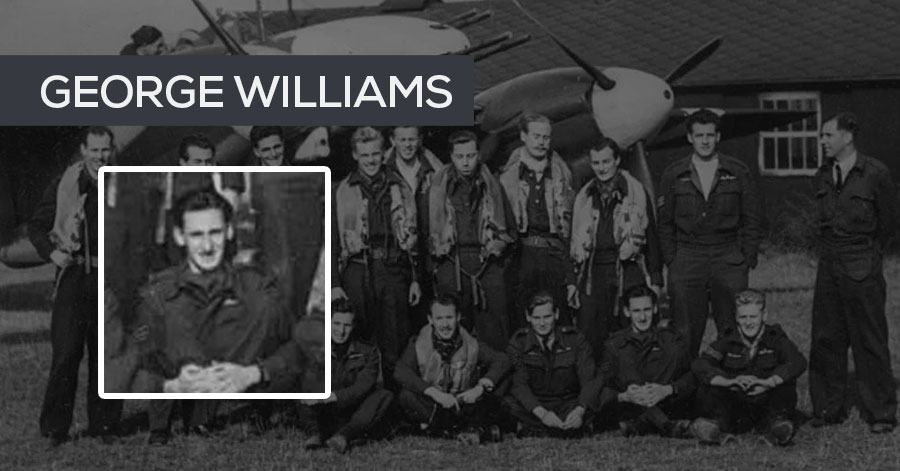
Flight Sergeant George Williams was a Hawker Typhoon pilot who flew from RAF Beaulieu as part of No. 263 Squadron RAF from 23 January to 6 April of 1944. His time flying from Beaulieu was short, as on 13 February that year he was shot down by anti-aircraft fire during a low-level fighter sweep over occupied France.
He was 263 Squadron’s second loss from Beaulieu after Norman Peter Blacklock, and is buried in a quiet village cemetery at Guillerval, south of Étampes in France.
This article pulls together what is currently known about George, his squadron and the operation that cost him his life.
George Williams
Family and early life
I’ve been unable to find much about George’s life and only have one photo of him. The Commonwealth War Graves Commission and the Guillerval Communal Cemetery register record him as:
- 1502741 Flight Sergeant George Williams
- Pilot, Royal Air Force Volunteer Reserve
- No. 263 Squadron
- Son of Owen and Mary Ellen Williams, of Wallasey, Cheshire
His headstone carries the family’s chosen inscription:
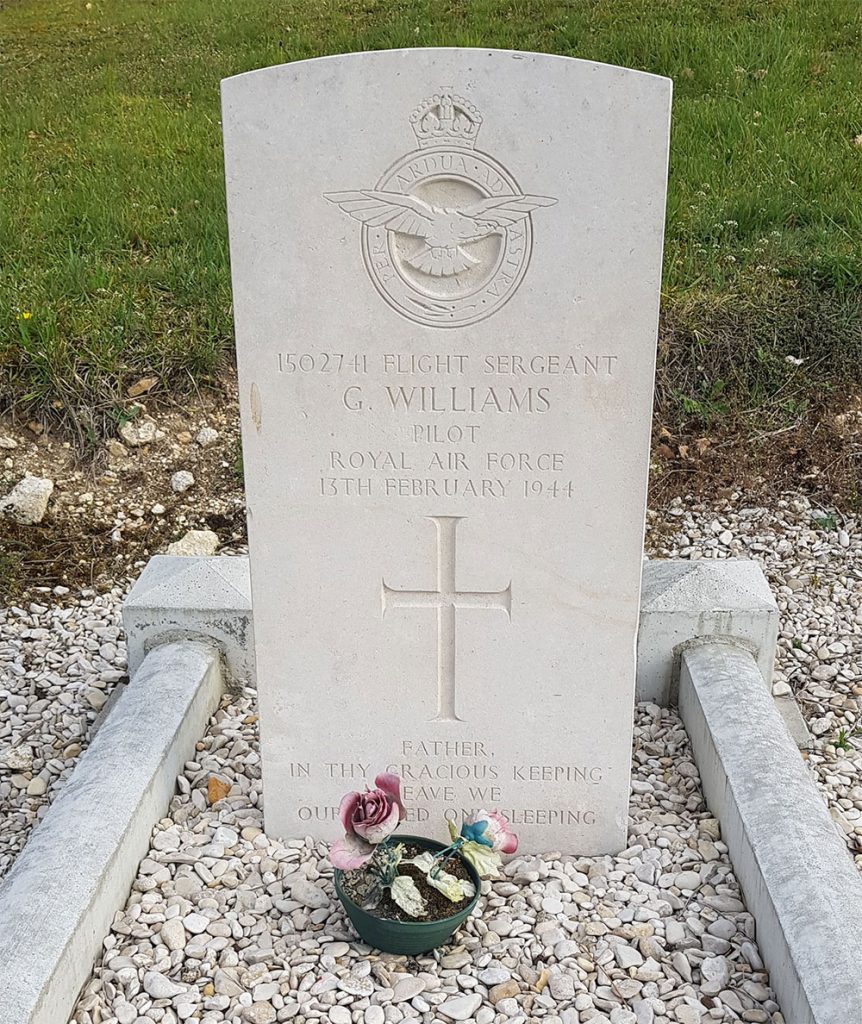
“Father, in Thy gracious keeping, leave we our loved one sleeping.”
Those few lines at least anchor George to a real place and a real family. His home was Wallasey, on the Wirral peninsula. He was one of thousands of young men who joined the RAF Volunteer Reserve during wartime.
In a newspaper cutting published five days after his death, I found this entry:
Mr. and Mrs. Owen Williams, of 277 Wallasey Village, have been notified that their son, Sergeant Pilot George Williams, lost his life while in action over occupied France during a sweep in which he had expressed a wish to join because it was his twenty-first birthday. Educated at the Central School, New Brighton, he was employed by Messrs. Ronald and Rodger, wool brokers, before joining the RAF three years ago. He was trained in Canada, and bad been a sergeant-pilot twelve months. A memorial service will be held St. Nicholas Church, Wallasey, 11 am Sunday.

Aside from that, I know little of his character. What is clear is that by early 1944 he was flying one of the RAF’s most demanding single-seat fighters, the Hawker Typhoon, with an experienced front-line squadron. That alone says something about his ability and determination.
263 Squadron, Whirlwinds and Typhoons
No. 263 Squadron RAF had already seen a great deal of war before George joined its ranks. But by late 1943, with the Whirlwind they were equiped with becoming increasingly hard to support and newer types coming into service, 263 Squadron began converting to the Hawker Typhoon Mk Ib. The Typhoon, powered by the 24-cylinder Napier Sabre, was a brutal, heavy fighter-bomber designed to operate at low level, armed with four 20 mm cannon and, later, bombs or rockets.
The squadron moved through a series of airfields as it converted, finally arriving at RAF Beaulieu in the New Forest in January 1944. After an armament practice camp, it became operational again on 1 February 1944, now as a Typhoon fighter-bomber unit. From Beaulieu the squadron’s operations were directed mainly against northern France and the Cherbourg peninsula: shipping, coastal defences, rail lines and V-weapon sites.
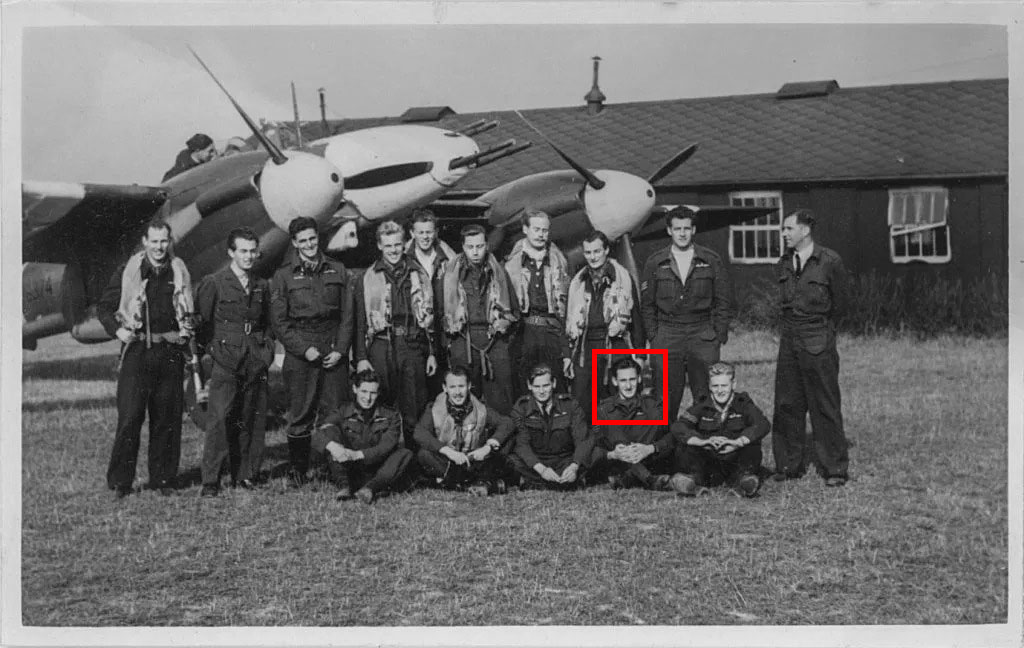
It was into this hardened, combat-experienced unit that Flight Sergeant George Williams slotted as one of the new Typhoon pilots. A group photograph of 263 Squadron Whirlwind pilots taken earlier in the war shows just how tight-knit these men were – a mix of British and Commonwealth airmen, many of whom would not survive to see peace. Later captions identify George as one of the seated pilots in similar squadron photos.
RAF Beaulieu, February 1944 – a dangerous month
When No. 263 Squadron RAF became operational from Beaulieu at the start of February 1944, the pace of activity was intense. The invasion of Normandy was only months away, and 2nd Tactical Air Force was systematically attacking German positions, airfields and communication lines across northern France.
The squadron’s first Typhoon operations went in straight away. Within days it was flying dive-bombing missions against V-weapon (Noball) sites and coastal targets, often in poor weather and against accurate flak.
These early operations proved costly.
- On 5 February 1944, Flying Officer Norman Peter Blacklock, another of the pilots photographed alongside George, failed to return from a night shipping reconnaissance in Typhoon JR251. His aircraft and body were never recovered.
- Barely a week later, on 13 February, George Williams himself would be killed.
- Before the month was out, the squadron’s commanding officer, Squadron Leader Geoffrey Berrington Warnes, along with Flying Officers Robert Bruce Tuff and Robert Charles Hunter, would be lost over the English Channel on 22 February.
For 263 Squadron, February 1944 really was a month of attrition: in just over three weeks the unit lost its CO and several front-line pilots, including George.
Rodeo 82: George’s final mission
The operation that cost George his life was a fighter sweep known as Rodeo 82.
In RAF terminology a ‘Rodeo’ was a fighter sweep over enemy-occupied territory – an offensive patrol designed to draw out enemy fighters, hit targets of opportunity and keep up pressure on the Luftwaffe. Some aspects of what happened that day were logged in the 263 Squadron Operations Record Book:
Overcast and cold. Afternoon, Rodeo 82. The C.O. destroyed an M.E. 109 F at Chartres and F/Lt G.G. Racine destroyed 3 more on the ground. Unfortunately, F/Sgt G. Williams was shot down by flak at Etamps/Mondesir Airfield, he must have been killed instantly. P/O W.E. Watkins’ a/c was also hit by flak he pulled up successfully to bale out at 1500 feet.
More detail is found in the recollections of one of George’s Canadian colleagues, Flight Lieutenant Gerald Geoffrey ‘Jerry’ Racine, DFC. He explained how in the afternoon a formation of six Typhoons of 263 Squadron took off from Beaulieu for Rodeo 82. The formation was led by Squadron Leader Warnes. According to the squadron records and Racine’s later write-up:
- After crossing the French coast, the Typhoons descended to low level – ‘zero feet’ – and swept towards their target area.
- Over Chartres, Warnes engaged and destroyed a Messerschmitt Bf 109 (in reality, later research suggests, a French-built Dewoitine D.520 in Luftwaffe service).
- Racine destroyed three more enemy aircraft on the ground during strafing passes.
But the action came at a terrible price.
The the operational records it notes, in stark language, that Flight Sergeant George Williams was hit by flak over Étampes–Mondésir airfield. His Typhoon, JR215, was seen to be struck and he was “shot down by flak… he must have been killed instantly.”
Guillerval Communal Cemetery
George’s body was recovered and he was buried in Guillerval Communal Cemetery in the Essonne department, about 50 km south of Versailles and a short distance south-west of Étampes.
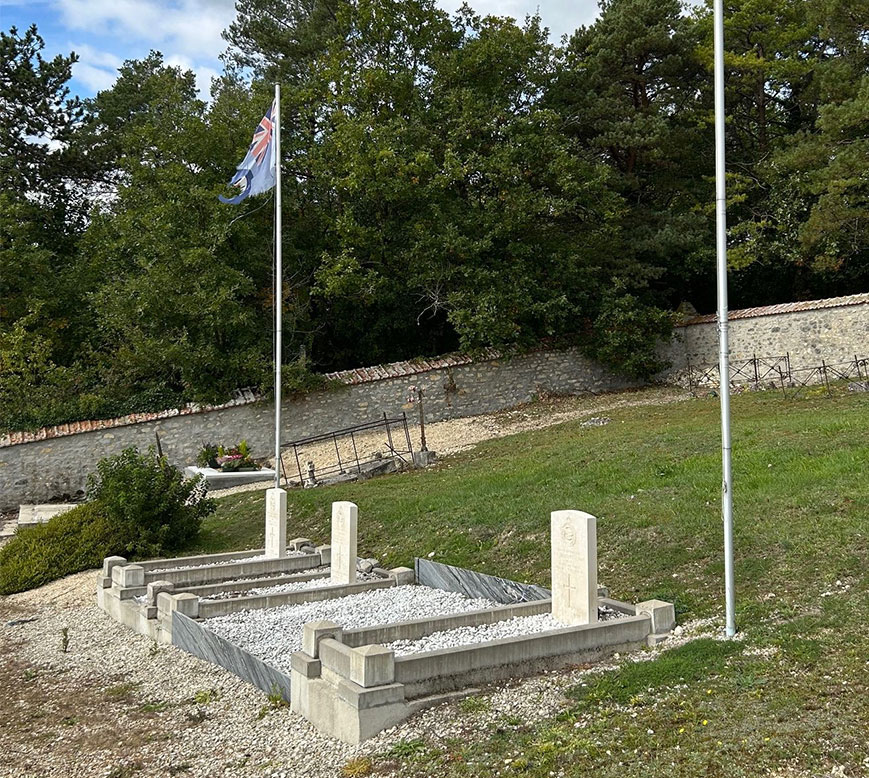
The cemetery contains just three British Second World War airmen, all RAF Volunteer Reserve pilots:
- Flying Officer Charles Ernest Austin, 245 Squadron (killed 16 March 1944)
- Flight Lieutenant Leslie Lawrence Whitaker DFC, 161 Squadron (killed 4 May 1944)
- Flight Sergeant George Williams, 263 Squadron (killed 13 February 1944)
George lies in Grave 1. His headstone, in the familiar Commonwealth War Graves style, carries the RAF eagle above the cross, with his name, rank, unit and date of death, followed by the family inscription chosen by his parents back in Wallasey.
The location is a quiet rural cemetery, far from his home on the Wirral and far from the New Forest airfield he flew from.
George Williams did not become a famous ace or a decorated leader. He represents something more typical – and in many ways more poignant: the skilled, ordinary volunteer pilot whose war lasted just a short while, who did everything that was asked of him and died far from home in a war of attrition.
If any relatives or friends of Flight Sergeant George Williams read this and are willing to share photographs, letters or memories, they would help greatly in rounding out the picture of the man behind the name, and in ensuring that his story is known, and preserved for future generations.


