

This article is in memory of Sergeant (later Flight Sergeant) Hugh Gordon Gillespie, a wireless operator / air gunner of 405 Squadron, Royal Canadian Air Force.
In November 1942 he was serving with 405 Squadron on Coastal Command duties, based out of RAF Beaulieu. During an anti-submarine patrol over the Bay of Biscay, an accidental gun discharge in flight left him critically wounded. He died eight days later, on 14 November 1942, in hospital at Truro, Cornwall. He was 31 years old.
Gillespie is buried in St Columb Major Cemetery in Cornwall.
Sergeant Hugh Gordon Gillespie
Early life in Saskatchewan and Manitoba
Hugh Gordon Gillespie was born on 20 October 1909 at Newburg, Saskatchewan. His parents were George Murray Gillespie, a farmer, and Ida Jane. Both would die before the war, leaving Hugh’s elder brother Robert Malcolm Gillespie as his next of kin by the time he enlisted in the Royal Canadian Air Force (RCAF).
By the late 1930s Hugh was living and working at Seven Sisters Falls in Manitoba, a small hydro-electric community on the Winnipeg River. His RCAF attestation paper lists his civilian occupation as ‘labourer’.
Joining the Royal Canadian Air Force
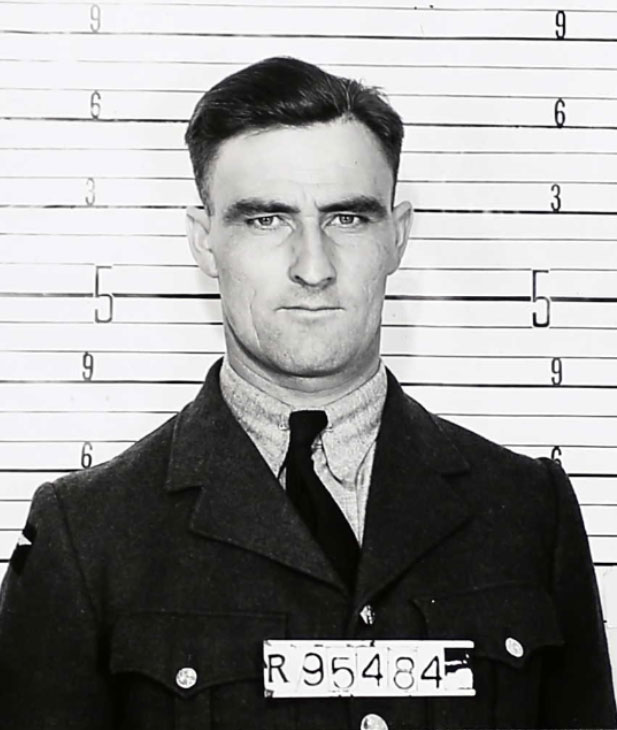
Hugh enlisted in the Royal Canadian Air Force in 1941, at the age of 31. This sets him apart from most recruits, many of whom were much younger, including teenagers. His RCAF identity card, issued at No. 1 Initial Training School at Camp Borden, Ontario, in July 1941, records him as:
- Age: 33
- Height: 5 ft 8½ in
- Weight: 153 lbs
- Hair: black
- Eyes: blue
- Distinguishing marks: ‘none visible’
His next of kin is given as his brother Robert, then living at Port Coquitlam, British Columbia. Robert would later receive the official letters about his injury and death.
Accepted for training as a wireless operator / air gunner, he went through the usual sequence of RCAF ground school and specialist courses. Wireless operators / air gunners (WOp/AGs) were dual-role crewmen, responsible both for radio communications and, when needed, a gun position in one of the turrets or waist stations of a bomber. It was demanding work that required technical skill, concentration and a certain amount of physical robustness – all of which a labourer in his thirties most likely had.
405 Squadron and Coastal Command
Hugh was eventually posted to 405 (City of Vancouver) Squadron, RCAF. Formed as the first Canadian bomber squadron overseas, 405 initially flew Wellington and Halifax bombers in Bomber Command, attacking targets in occupied Europe. By mid-1942 the squadron had been detached to Coastal Command to fly anti-submarine and anti-shipping patrols in the Bay of Biscay and Western Approaches. From bases including RAF Beaulieu and RAF St Eval in Cornwall.
In the squadron Hugh served as a wireless operator / air gunner. Operations Record Books and later summaries list him as a member of a ‘first-class crew’ on Halifax W7768 ‘G’, flying anti-submarine patrols over the Bay of Biscay. Highlighting the risks men like Gillespie faced, just six weeks after his death, on 20 December 1942, that same Halifax would crash on the Isle of Wight with the loss of seven men onboard.
The accident on 6 November 1942
The tragedy that would end Hugh Gordon Gillespie’s life did not come from enemy action, but from a freak accident in his own aircraft.
On 6 November 1942, aircraft from 405 Squadron took off from RAF Beaulieu for an anti-submarine patrol over the Bay of Biscay. Hugh Gordon Gillespire was onboard Handley Page Halifax Mk II (W7768) ‘G’, which left the runway at 07:35 am.
According to the squadron Operations Record Book (ORB), at 09:58 hours the mid-upper gunner of Hugh’s Halifax tested his guns, found that one was unserviceable and tried to clear the fault. As he did so, the gun went off by itself. A burst of bullets tore through the aircraft’s fuselage and struck the rear gunner – Sergeant Hugh Gordon Gillespie – in the lower back, “mortally wounding him”. The ORB notes that the firing controls were not touched during the accidental burst.
The captain immediately set course for St Eval in Cornwall, sending a signal requesting medical assistance. On landing, Gillespie was transferred to an ambulance and taken to hospital in what the log records as a ‘dangerous condition’. The incident was classified as an operational accident rather than enemy action.
A letter from the RCAF Casualties Officer in Ottawa, dated 12 November 1942, informed Hugh’s brother that he had been ‘dangerously injured’ on 6 November 1942, suffering from a bullet wound in the lower back after ‘one of the guns of an aircraft accidentally discharged while being loaded, firing one or more rounds through the fuselage’. It reassured Robert that his brother was receiving the best of medical attention and promised further news when available.
That news came all too soon. On 14 November 1942, eight days after the accident, Hugh died of his injuries at the Royal Infirmary in Truro, Cornwall.
Burial at St Columb Major Cemetery
Hugh was buried with full military honours on 17 November 1942 in St Columb Major Cemetery, a short distance inland from the north Cornish coast.
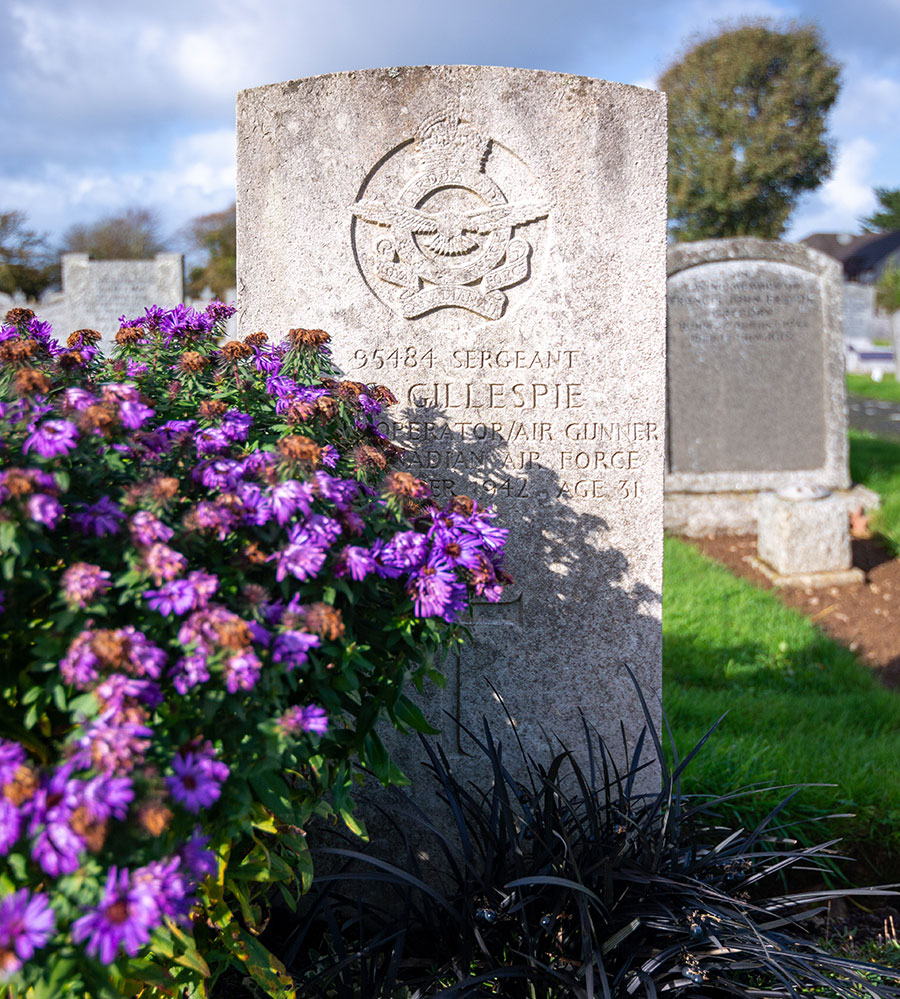
The Commonwealth War Graves Commission records his grave as number 1319. His headstone carries the standard RCAF badge and the inscription that he is the son of George Murray and Ida Jane Gillespie of Port Coquitlam, British Columbia – an address which reflects his brother’s home rather than his own pre-war life in Manitoba.
Letters home and posthumous promotion
A letter from Wing Commander L. G. Fraser, commanding 405 Squadron, was sent to Hugh’s brother Robert shortly after the accident. In it, Fraser explains that Hugh had been fatally injured in an air accident while on an operational flight, and that he was a popular member of the squadron and part of an ‘excellent crew’ doing a ‘wonderful job’. He also mentions that photographs of the funeral were being sent to Canada, a common practice when families could not attend.
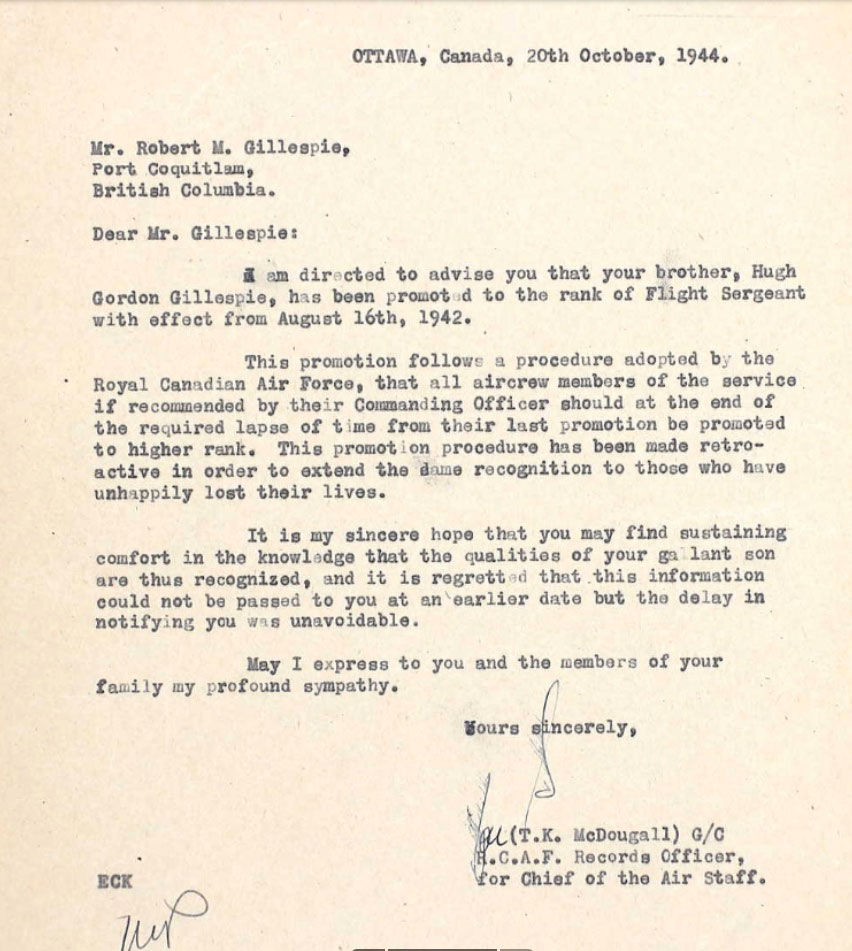
Two years later, in October 1944, Robert received another letter from Ottawa. This one informed him that his brother had been posthumously promoted to the rank of Flight Sergeant, effective from 16 August 1942. The promotion followed an RCAF policy of advancing aircrew in rank after a certain period if recommended by their commanding officer. For those who had died, the policy was applied retroactively ‘to extend the same recognition to those who have unhappily lost their lives’.
Official records such as CWGC continue to list him as Sergeant – reflecting his rank at the time of death – but the Canadian files and later summaries often describe him as Flight Sergeant Hugh Gordon Gillespie, acknowledging the promotion that his service had earned.


