
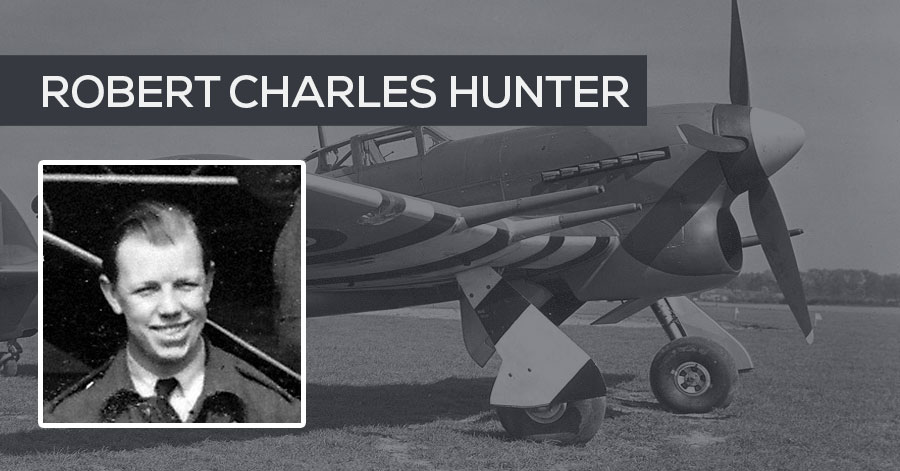
Flying Officer Robert Charles Hunter was a Royal Air Force Volunteer Reserve fighter pilot who flew Hawker Typhoons with No. 263 Squadron RAF in early 1944. On 22 February that year he was lost over the English Channel during a shipping reconnaissance near the Channel Islands. Robert’s body was never recovered, so, he has no grave, yet is commemorated on the Air Forces Memorial at Runnymede, Panel 207.
Robert Charles Hunter
Family and early life
Robert was born on 25 May 1921. His address was listed as 215 Lea Road in Wolverhampton. He was the son of Charles Henry and Elsie Dora Hunter, and in the 1939 census, his occupation is listed as ‘rubber worker’.

I’ve not been able to find out much about his personal life, other than a newspaper article from 2002 where his son (un-named) is referenced in an appeal to find relatives of his dead father.
‘The son of a wartime flier has enlisted the help of the 102 (Ceylon) Squadron Association to help find relatives who could be living in Wolverhampton. Tom Wingham, honorary secretary of the association says that the son of Flying Officer Robert Charles Hunter, who was killed in February 1944, is trying to track down any relatives. His grandparents Charles Henry and Elsie Dora Hunter and aunt Eve were living in Wolverhampton at the time his father died.’
Based on this, it appears Robert had a son and sister named Eve.
Wolverhampton’s own Second World War roll of honour lists him as:
- Flying Officer Robert Charles Hunter
- Service number 150009
- Royal Air Force Volunteer Reserve
Several online sources, including the Commonwealth War Graves Commission, write that he was part of 63 Squadron. This is likely an error, as he was part of No. 263 Squadron on the day of his death.
Joining the RAF

Robert served in the RAF Volunteer Reserve the wartime route by which most British fighter pilots came into the service.
The London Gazette shows 1577439 Robert Charles Hunter being granted an emergency commission as an officer with the new service number 150009, which fits the usual pattern of an NCO pilot being commissioned after completing training and gaining experience.
It appears he was in No. 137 Squadron RAF after training, as the Operational Record Book for that squadron records him on 16 July 1943 as being one a group of new pilots from No. 55 Operational Training Unit being trained in Whirlwind flying, bombing practice, and tactics.
263 Squadron and the move to Typhoons
By late 1943 Robert was serving with No. 263 Squadron RAFa long-standing fighter squadron that had previously flown the Westland Whirlwind on coastal and offensive operations.
Later the squadron converted to the Hawker Typhoon, part of 2nd Tactical Air Force. On 1 February 1944 the squadron became operational in Typhoons from RAF Beaulieu, flying offensive sweeps, armed reconnaissance and shipping strikes over northern France, the Cherbourg peninsula and the Channel Islands in preparation for the Allied invasion.
22 February 1944 – Rodeo 88 and the losses north-west of Guernsey

On 22 February 1944, aircraft from 263 Squadron was tasked with an operation coded Rodeo 88. The plan was a fighter sweep over occupied France. Despite being based at Beaulieu, the Typhoons took off from RAF Harrowbeer in Devon for that mission.
Weather over the French coast was poor, with heavy cloud. The sweep was abandoned and the formation instead carried out a shipping reconnaissance west of the Channel Islands, patrolling an area to the north-west of Guernsey. There was no enemy air opposition and no recorded combat.
Over the patrol area, events unfolded quickly:
Squadron Leader Geoffrey Berrington Warnes DSO DFC, the commanding officer, flying Typhoon MN249, suffered an engine failure and was forced to ditch in the sea about eight miles north-west of Guernsey. Other pilots circled while he escaped from the aircraft and was seen swimming towards what appeared to be an uninflated dinghy.
Flying Officer Robert Bruce “Bob” Tuff, an Australian pilot in Typhoon JR302, radioed that he intended to bail out to try to help his CO, despite warnings from another pilot that the conditions made rescue almost impossible. He was never seen again.
Flying Officer Robert Charles Hunter, flying Typhoon JR304, continued to circle the scene as the drama unfolded below. At some point during this difficult period, his aircraft also went missing; he is recorded as having “disappeared while circling the area”. No wreckage or body was recovered.
The squadron’s circumstantial report and later research agree that the sea was rough and the water extremely cold, with little chance of survival for anyone forced down.
In a matter of minutes, and without any enemy action, three experienced Typhoon pilots – the CO and two of his officers – were lost to the Channel. For 263 Squadron, already under pressure in the run-up to the invasion, it was a tragic day.
No grave, but is still commemorated
Like his comrades Warnes and Tuff, Robert Charles Hunter has no known grave. All three are commemorated on the Air Forces Memorial at Runnymede, which records by name more than 20,000 Commonwealth airmen with no known resting place. Robert’s name appears on Panel 207.


