
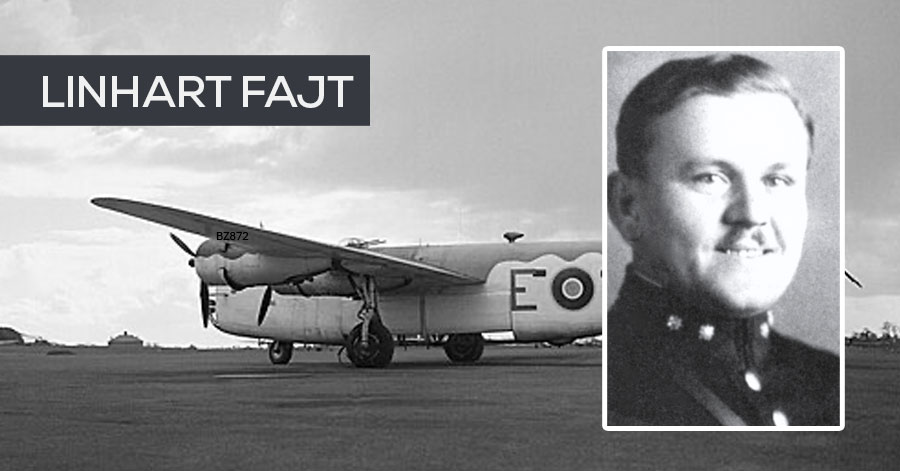
This article is in memory of Sergeant Linhart Fajt, a Czech flight engineer with No. 311 (Czechoslovak) Bomber Squadron RAF. On 17 November 1943 he took off from RAF Beaulieu on an anti-submarine patrol over the Bay of Biscay in a Liberator of Coastal Command. His aircraft was lost the following day, 18 November.
The reports on this website are intended to keep alive the memory of the men and women who served at Beaulieu during the war and in the immediate post-war years. Some gave their lives in the process.
Sergeant Linhart Fajt
Early life
Linhart Fajt was born on 26 November 1910 in the small town of Jablonné nad Orlicí, then in Austria-Hungary. His father was also called Linhart, and his mother was Julie, née Krejčí. When he was still a small child the family moved to Litovel, where his father set up a brush-making business.
The First World War shattered their family life. His father was called into service in 1914, captured on the Eastern Front, later joined the Czechoslovak Legions, and died of wounds in Chelyabinsk in 1918. His brother Alois died a year earlier, in 1917. Linhart’s mother was left to raise three children and keep the workshop going on her own.
Growing up in Litovel, Linhart went through school and eventually trained as a car mechanic – skills that would later prove vital in the RAF.
Mechanic, soldier, wrestler, policeman
In 1930 he began his compulsory military service and completed a drivers’ and mechanics’ course at Milovice. Outside the barracks he had a strong interest in sport. He personally knew the famous Czech wrestler Gustav Frištenský, who gave him wrestling lessons. According to later accounts, Linhart was a keen and capable wrestler. I have to assume he was physically tough and disciplined.
After leaving the army he returned to civilian life and in 1934 he became a policeman in Litovel, settling into what must have looked like a steady career in a quiet provincial town.
But within a few years, events in Europe would turn that life upside down.
German occupation and resistance work
In March 1939 German forces occupied the Czech lands and created the Protectorate of Bohemia and Moravia. For many in the country this was a turning point; some chose to keep their heads down, but others quietly began to resist, including Linhart.
He joined an underground group committed to resistance. The group gathered and hid weapons, sheltered people who were being persecuted, and helped them escape abroad. Among those they helped were men such as Ladislav Bedřich, Karel Kvapil, Josef Kuhn and Ladislav Hrabal.
In early 1940 the Gestapo uncovered the clandestine group’s activities. Arrests followed, but Linhart and his friend Josef Plánička managed a narrow escape. They slipped out of the Protectorate and began a long and dangerous journey into exile.
Journey into exile and the road to Beaulieu
The escape route took them via Slovakia and Hungary, then through the Middle East, before they finally reached France. There, Linhart joined the newly formed Czechoslovak Army in exile. At his own request he was assigned to the air force and, on 15 March 1940 at Agde, he was posted to air units.
When France collapsed under German attack that summer, the Czechoslovak forces had to evacuate again. On 19 June 1940 Linhart boarded a boat from Bordeaux and arrived in England. He was one of thousands of Czechoslovak servicemen who chose to continue the fight from Britain.
On 11 July 1940 he was accepted into the Royal Air Force, and on 29 July he was posted to the ground staff of No. 311 (Czechoslovak) Squadron RAF.
With 311 (Czechoslovak) Squadron – ground crew years
No. 311 (Czechoslovak) Squadron RAF was formed in the summer of 1940. It was the only Czechoslovak-manned medium and heavy bomber squadron in the RAF, and suffered some of the heaviest losses of any Czechoslovak unit during wartime. One month in August 1943 was particularly bad. Watch my film below.
The squadron began its operational life flying Vickers Wellington bombers during night bombing raids over occupied Europe. In 1942 it transferred to Coastal Command, operating from RAF Aldergrove and RAF Talbenny on anti-submarine patrols.
During these years Linhart worked as ground crew, keeping the squadron’s aircraft flying. It could be exhausting work in all weathers, but was a vital part of keeping operations going.
In 1943 the squadron began converting to the four-engined Consolidated Liberator, a long-range maritime patrol aircraft. On 26 May 1943 311 Squadron moved to RAF Beaulieu in the New Forest, from where it would operate over the Bay of Biscay.
Training as an airborne flight mechanic
By 1943, with years of mechanical experience behind him, Linhart volunteered to move from the ground crew to the aircrew. Between February and September 1943, he completed training as an airborne flight mechanic; effectively the flight engineer on the Liberators.
On a Liberator the flight engineer monitored the four engines, the fuel systems, and key instruments, assisted the pilots with power settings during take-off and landing, and helped manage any technical problems in flight. On Coastal Command Liberators, he could also man a gun position when required.
His first operational sortie took place on 6 November 1943. Just twelve days later he would be lost on only his third mission.
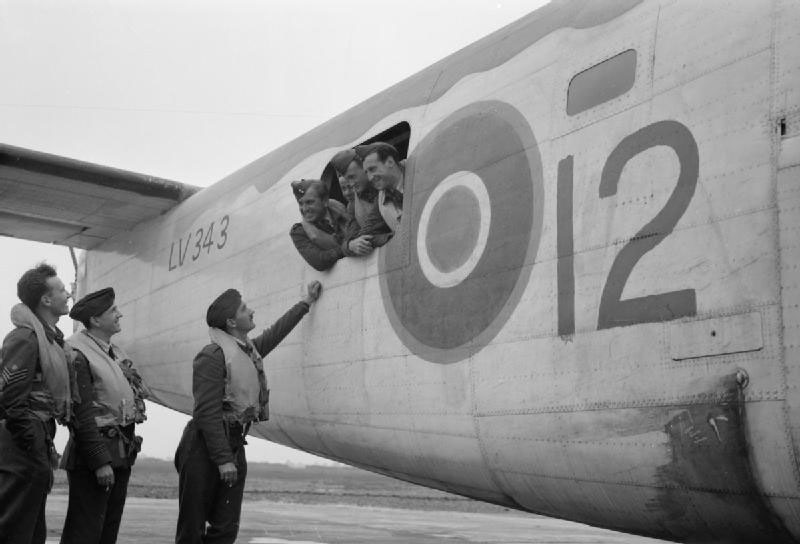
311 Squadron and RAF Beaulieu in 1943
By the time Linhart joined the aircrew, No. 311 (Czechoslovak) Squadron RAF had changed role. From RAF Beaulieu they now flew long anti-submarine patrols over the Bay of Biscay, hunting down German U-boats transiting to and from bases on the French coast.
The Bay of Biscay was one of the most dangerous areas for Allied airmen. German long-range fighters and improved anti-aircraft guns on the U-boats meant that every patrol carried a high level of risk. Liberators might be airborne for ten to twelve hours or more, far from land and often in poor weather.
The crew of Liberator BZ872 “E”
On 18 November 1943, Linhart flew as flight engineer in Liberator GR Mk.V BZ872, squadron code “E”. The aircraft had been with the squadron for only a short time.
The crew that night were:
- Flight Lieutenant Metoděj Šebela DFC – pilot and captain
- Flight Sergeant Miroslav Procházka – second pilot
- Flying Officer Alois Vávra – navigator
- Flight Sergeant Ladislav Černohorský – wireless operator / air gunner
- Flight Sergeant Albert Fuksa – air gunner
- Sergeant Felix Arnošt Heller – wireless operator / air gunner
- Sergeant Josef Novák – wireless operator / air gunner
- Flying Officer Emerich (Hannes) Urban – air gunner
- Sergeant Linhart Fajt – flight engineer([fcafa.com][1])
Šebela was a highly experienced captain, with many operations behind him and a Distinguished Flying Cross to his name. For Linhart, however, this was only his third sortie as aircrew.
The final mission – 17/18 November 1943
The Liberator took off from RAF Beaulieu late on 17 November 1943, just before midnight, for a long anti-submarine patrol over the Bay of Biscay. The patrol continued into the following day.
At 13:10 hours on 18 November a radio message came in from BZ872 reporting engine trouble and indicating that the crew might have to ditch at sea. It was described later as a “rather cryptic” distress signal, but it was clear that something was seriously wrong.
What happened next can only be taken from German records and post-war research. German sources claim that a Liberator was intercepted in the Brest area by two Messerschmitt Bf 109 fighters and shot down over the Bay of Biscay. It is widely believed that this was BZ872 – Linhart’s aircraft.
A US Navy Liberator from Dunkeswell was sent out to search for survivors. The crew reported seeing a large spreading patch of oil on the sea but found no wreckage and saw no bodies in the water.
BZ872 and the nine crew were missing.
Loss, recovery and burial
For most of the crew, the Bay of Biscay became their grave. The aircraft itself and eight of the airmen were never recovered. Their names are remembered on Czechoslovak rolls of honour, and the missing men from 311 Squadron are associated with the Air Forces Memorial at Runnymede, which commemorates airmen with no known grave.
Linhart’s body was the only one the sea returned. It was washed ashore on the coast of Normandy and was initially buried by American forces in a US military cemetery as an unknown airman.
After the war his remains were exhumed and identified as those of Sergeant Linhart Fajt, RAFVR, service number 787091. His grave is now in the Commonwealth War Graves Commission cemetery at Bayeux, France (Bayeux War Cemetery, Plot VIII, Row C, Grave 19). His headstone carries both his RAF rank and his later Czechoslovak rank of staff sergeant.
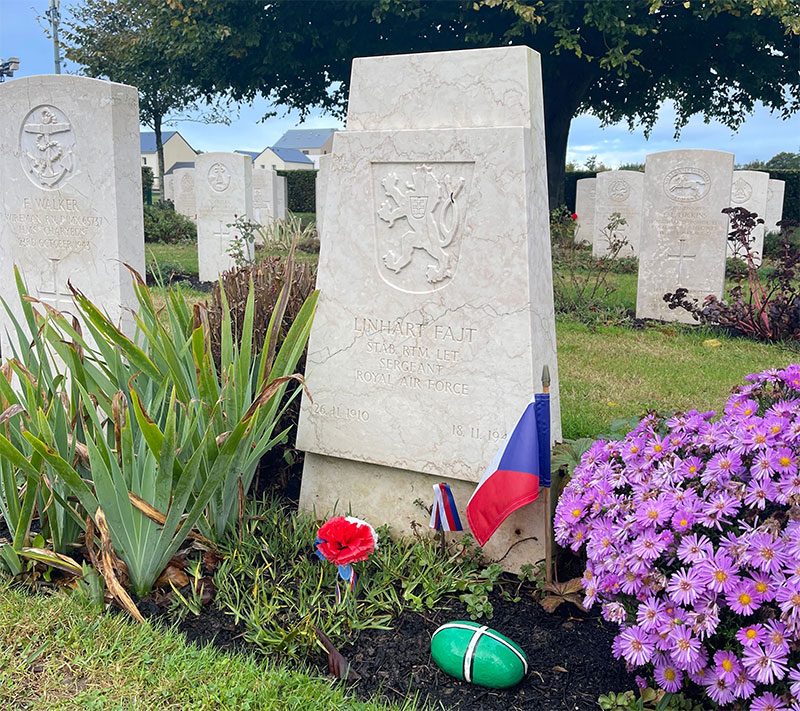
From the New Forest to the Bay of Biscay and finally to a quiet grave in Normandy, his journey took him far from the streets of Litovel where he began a simple life, and could not have imagined what his future held.
What happened to his family
Back in occupied Czechoslovakia, his decision to escape and fight with the RAF brought heavy consequences for his family.
After Linhart left the Protectorate, his mother Julie was repeatedly interrogated by the Gestapo. In time she and his sister, also named Julie and already suffering from a lung disease, were interned in the Svatobořice camp. Conditions there were harsh. His sister never fully recovered from her imprisonment and died three years after the war as a result of her illness and the damage done to her health.
The cost of his service was therefore felt not only at sea in 1943, but also at home in the years that followed.
Post-war recognition and remembrance
After the war the Czechoslovak authorities recognised Linhart’s service and sacrifice. He was promoted in memoriam to the rank of staff sergeant (štábní rotmistr), and in 1991, after the fall of communism, he was promoted again in memoriam to lieutenant colonel (podplukovník).
He was also awarded the Czechoslovak War Cross 1939 in memoriam.
Today he is commemorated in several places: on memorials and plaques in his birth town of Jablonné nad Orlicí, in Litovel, and at national memorial sites in the Czech Republic, as well as on his grave in Bayeux. His name appears in Czechoslovak air force casualty lists and in modern projects dedicated to preserving the memory of the 311 Squadron airmen.
Linhart Fajt and RAF Beaulieu
It’s rather poignant today, when walking the old perimeter tracks and patches of broken concrete in the heather, to forget that men from occupied countries once stood here, preparing to fly some of the most dangerous missions of the war. Linhart had already served his country as a mechanic, a policeman and a resistance worker before he ever saw the New Forest. At Beaulieu he took on a new and final role as flight engineer and paid for it with his life.
References
- Commonwealth War Graves Commission – casualty details for Sergeant Linhart Fajt (787091), Bayeux War Cemetery
- Czech Wikipedia – “Linhart Fajt” (cs.wikipedia.org)
- Free Czechoslovak Air Force Associates – “311 Sqn – Never Regard Their Numbers – Coastal Command”
- Free Czechoslovak Air Force Associates – “Liberator aircraft of 311 Sqn”
- Válka.cz – “Fajt, Linhart”
- VPM / vets.cz – grave record for Linhart Fajt, Bayeux War Cemetery
- Articles on Metoděj Šebela and 311 Squadron in Coastal Command history


