

The last quarter of 1942 was extremely bleak at RAF Beaulieu – if you consider the context of how many lives were lost. Ten men were lost in October, eighteen in November, and fourteen in December. In addition to that, fifteen more died in an air crash enroute to Beaulieu Airfield from RAF Ripon in Yorkshire. The total death toll came to fifty-seven airmen who were connected to RAF Beaulieu, in just three months.
One of those tragedies that attributed to this high death toll unfolded in the early hours of Sunday 20 December 1942, when Handley Page Halifax Mk II W7768, of 405 Squadron (Royal Canadian Air Force), crashed into farmland near the village of Newbridge on the Isle of Wight. All seven men on board were killed.
I understand that a small memorial exists at the crash site on the Isle of Wight. Six of the crew are buried at Boldre churchyard near Beaulieu, with one man buried in Cardiff.
This is the story of Halifax W7768 and her crew.
405 Squadron (RCAF) at RAF Beaulieu
405 Squadron (RCAF), arrived at RAF Beaulieu in 1942 as part of RAF Coastal Command, detached from Bomber Command. From Beaulieu Airfield they conducted long-range patrols over the Bay of Biscay and the Western Approaches, hunting German U-boats, shadowing enemy shipping, and flying mine-laying and anti-shipping missions.
These sorties were often long, low, and hazardous, carried out in winter weather over cold seas, with the constant threat of enemy aircraft and anti-aircraft fire. On top of that, crews had to contend with the reliability issues that could plague heavy four-engined aircraft still being pushed hard in wartime service.
By mid-December 1942, Beaulieu had already seen several horrific events involving 405 Squadron aircraft. In November, Halifax W1152 failed to return from an anti-shipping raid at the Gironde estuary, France – six lives were lost on that occasion. In the same month, Halifax W1096 crashed in Essex with the loss of four lives. At the end of November, another 405 Squadron aircraft crashed at Melmerby near Ripon while en route to Beaulieu. On 15 December, Halifax DT624 crashed a mile from the airfield, and seven men were killed.

The loss of Halifax W7768 comes at the end of this bleak sequence.
Handley Page Halifax Mk II W7768
W7768 was a Handley Page Halifax Mk II, a four-engined heavy bomber adapted for Coastal Command duties. In 405 Squadron she carried the squadron code letters “LQ-G” and was used on anti-shipping and anti-submarine patrols from Beaulieu.
Like many Halifaxes in Coastal Command, W7768 would have been fitted for long-range operations, carrying extra fuel, radar and other equipment as well as her normal defensive armament. On 20 December 1942 she was crewed by a mixture of Canadian and British airmen, most of them in their early twenties – with one just nineteen years old.
The final flight on 20 December 1942
In the early and dark winter morning of Sunday 20 December 1942, the heavy bombers of 405 Squadron started warming up on the Beaulieu runways. Halifax W7768 was the first of four aircraft to leave, with her take-off time logged at 06:46. All were bound on an anti-shipping patrol in the English Channel. At the controls was Warrant Officer Class II Lloyd Elsworth Snarr, a 22-year-old Royal Canadian Air Force pilot from New Brunswick, Canada, with a crew of six accompanying him.
Halifax W7768 rumbled down the runway, then climbed away to the south-west, heading towards the Isle of Wight. As the large aircraft passed over the west coast of the Island and continued to climb, one engine is believed to have suffered a catastrophic failure. Within seconds the Halifax became uncontrollable.
Witnesses saw the bomber turn, lose height rapidly and plunge vertically into the ground at Eades Farm near Newbridge. The time was 06:58, she’s only been in the air for twelve minutes. On impact the aircraft broke up and exploded, scattering debris and unexploded bombs over the surrounding fields.
Rescuers reached the scene quickly, but they were confronted by intense heat, burning wreckage and the danger of high explosives scattered around the site. There were no survivors. All seven crewmen had been killed on impact.

Aftermath and investigation
Official summaries and later research agree that a sudden engine failure while the aircraft was still at relatively low altitude was the root cause of the crash. A heavy four-engined bomber loaded for an operational patrol had little margin for error if a major failure occurred so soon after take-off, especially at night and over rising ground.
The operational records for 405 Squadron read how it was on an anti-submarine patrol to the Bay of Biscay:

Four of our a/c were detailed for patrols which were uneventful but unfortunately one of our a/c “C”, had engine trouble and crashed and burned out on the Isle of Wight. Shortly after take-off a report was received by flying control that a four-engine bomber had crashed but since no report had been received by base from any of our a/c reporting that they were in difficulty, it was some time before it could be ascertained which of our a/c had crashed. Cause of the crash is unknown and since all members of the stricken a/c perished, it was impossible to secure any information about this unfortunate accident.
The subsequent RAF crash report is quite hard to read, but the best I can decipher the handwriting is as follows:
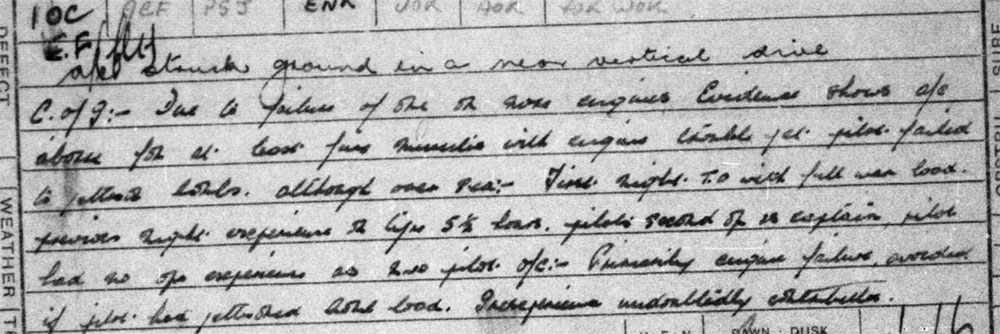
Struck ground in a near vertical dive… due to failure of one of more engines. Evidence shows a/c airborne for at least five minutes with engines… yet pilot failed to jettison bombs. Although over sea… time night. T.O. with full war load. Previous night experience 5½ hrs. Pilot second op as captain, pilot had no op experience as … Primary engine failure avoided if pilot had jettisoned war load. Inexperience undoubtedly contributed.
Burial and remembrance
Six of the men from Halifax W7768 were buried together in the quiet churchyard of St John the Baptist at Boldre, a short distance from RAF Beaulieu. Their graves form a poignant row among other wartime burials, including fellow 405 Squadron airmen from earlier and later crashes. The seventh member of the crew, Pilot Officer Robert Washer, was taken home to Wales and is buried at Cathays Cemetery in Cardiff.
On the Isle of Wight, a small memorial marks the crash site near Newbridge, listing the names and ranks of the men who died there. At Boldre church, embroidered hassocks bearing the initials and badges of 405 Squadron airmen serve as a lasting tribute from the local community to the Canadians and Britons who never returned from their flights.
The crew of Halifax W7768
Below is a brief biographical sketch of each airman lost in the crash of Halifax W7768.
Warrant Officer Class II Lloyd Elsworth Snarr (22) – pilot

Lloyd Elsworth Snarr was born on 2 November 1920 at Pointe-du-Chêne, New Brunswick, Canada. He was the son of Appolus William and Flora Mabel Snarr and grew up in Moncton, New Brunswick.
Snarr enlisted in the Royal Canadian Air Force and qualified as a pilot, joining 405 (City of Vancouver) Squadron. At the time of the crash, he was 22 years old and serving as Warrant Officer Class II. He was captain of Halifax W7768 on the morning of 20 December 1942.
Lloyd Snarr is buried in Boldre (St John) Churchyard, Row 2, Grave 1. His headstone inscription reads: “Safe in the arms of Jesus safe on His gentle breast.”
Flying Officer Ernest Stollery (21) – observer / air bomber
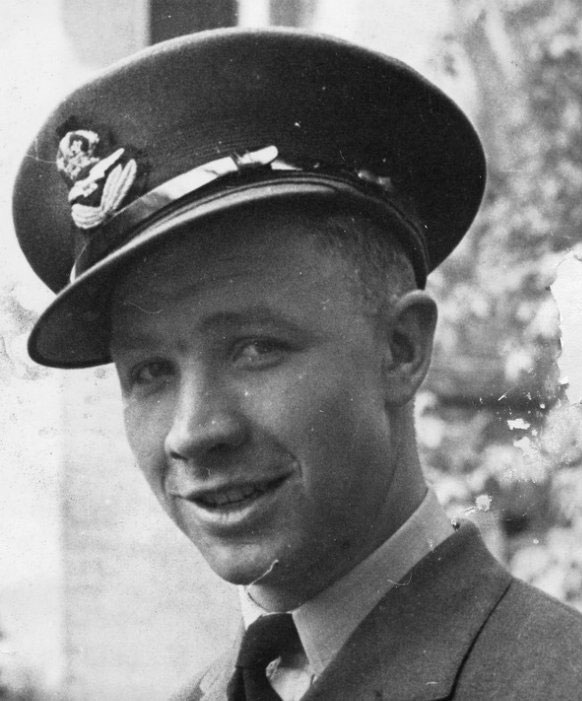
Flying Officer Ernest Stollery served with the Royal Canadian Air Force as an air observer, a role that combined navigation and bomb-aiming duties. He was 21 years old and came from Edmonton, Alberta. He was William Charles and Kate Stollery. The inscription on his headstone reads:
FATHER,
MAKE US CLEARLY SEE
THE PART WE HAD IN THIS.
IN THY MERCY HEAL US ALL
He is buried at Boldre (St John) Churchyard, Row 2, Grave 6.
Flight Sergeant Norman Albert Van Brunt (21) – wireless operator / air gunner

Norman Albert Van Brunt was from Vancouver, British Columbia. He served with 405 Squadron as a wireless operator / air gunner, responsible for radio communications and also manning the guns when required.
Van Brunt was 21 years old when he died in the crash at Newbridge. He was well known in Saskatoon, Canada, as an amateur boxer and he was a member of the Maple Leaf Boxing Club. He came with his parents to Saskatoon about 1921 and attended Buena Vista School. He was employed at the Great West Saddlery Company prior to his enlistment in the RCAF in July, 1941, at Vancouver. He went overseas in May, 1942.
He is buried at Boldre (St John) Churchyard, Row 2, Grave 5.
Flight Sergeant Gerald Edward Wagner (19) – air gunner
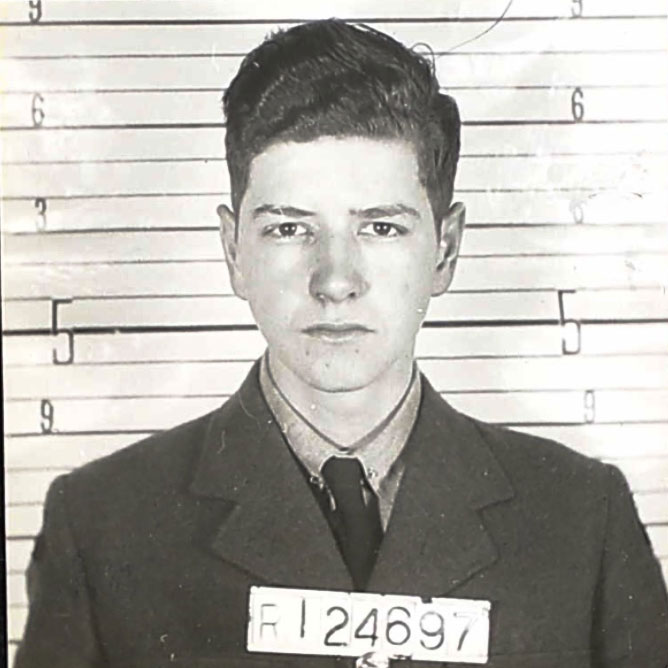
Gerald Edward Wagner was the youngest member of the crew. Born in May 1923, he was the son of Duncan and Alma Wagner (née Nicholson) of Sydney, Nova Scotia, and the grandson of Mrs A. J. Nicholson, also of Sydney. His mother died when he was one year old, and he was brought up by his grandparents.
Wagner enlisted in the RCAF and qualified as an air gunner, joining 405 Squadron at Beaulieu. On W7768 he served as one of the gunners defending the aircraft against enemy fighters. He was just 19 years old when he was killed at Newbridge.
Flight Sergeant Wagner rests in Boldre (St John) Churchyard, Row 2, Grave 4 – read Gerald Edward Wagner’s story.
Sergeant Morris William Croft (20) – flight engineer
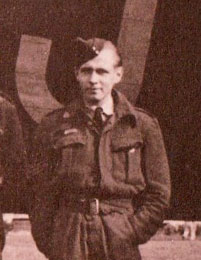
Sergeant Morris William Croft was the only non-commissioned British member of the crew. He served in the Royal Air Force as a flight engineer, responsible for monitoring the Halifax’s four engines, fuel systems and many of the aircraft’s mechanical systems during flight.
Croft was from Derby and was only 20 years old at the time of his death. As flight engineer he would have been working shoulder-to-shoulder with Warrant Officer Snarr in the cockpit when the engine failure occurred.
He is buried with his Canadian comrades in Boldre (St John) Churchyard.
Sergeant Michael William Fugere (29) – air gunner
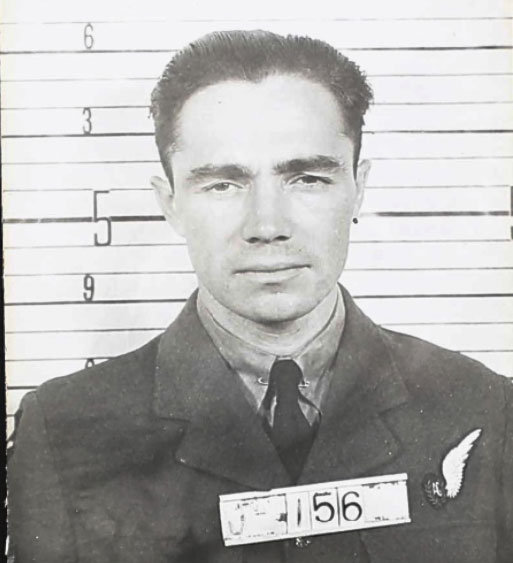
Sergeant Michael William Fugere was a Canadian air gunner with 405 Squadron. He was a French national born in the UK but moved to Canada in 1930. He was married to Margaret Grace Fugere (née Bell), with whom he had two daughters, Barbara and Leona.
As an air gunner, he would have manned one of the Halifax’s defensive turrets, watching for enemy fighters during the long patrols over the Bay of Biscay.
Sergeant Fugere is buried at Boldre (St John) Churchyard, Row 2, Grave 2.
Pilot Officer Robert Washer (31) – bomb aimer / navigator
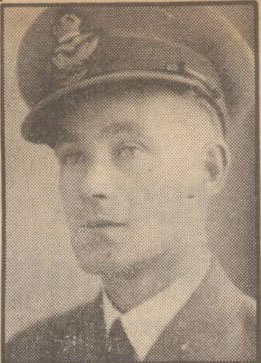
Pilot Officer Robert Washer served with the Royal Air Force Volunteer Reserve, attached to 405 (RCAF) Squadron. On W7768 he is described in contemporary records as the bomb aimer / navigator.
Washer was 31 years old when he died in the crash – noticeably older than most of his crewmates. He is buried at Cardiff (Cathays) Cemetery, Section L, Grave 225, and is also commemorated on local memorials in Cardiff.


