

This article is in memory of Flight Sergeant Gerald Edward Wagner, an air gunner of 405 Squadron, Royal Canadian Air Force. In December 1942 he was serving at RAF Beaulieu, flying in Handley Page Halifax Mk II W7768 on long-range patrol work for Coastal Command.
On the morning of 20 December 1942, W7768 crashed into fields near Newbridge, close to Calbourne on the Isle of Wight. All seven crew were killed. Gerald was the youngest at just nineteen years old. He is buried alongside five other members of the crew in St. John the Baptist Churchyard in Boldre.
Gerald Edward Wagner
Early life in Sydney, Nova Scotia
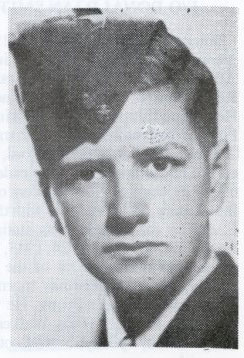
Gerald Edward Wagner was born on 25 May 1923 in Sydney, Nova Scotia, Canada. His father was Duncan Wagner, a truck driver, and mother was Alma Wagner, née Nicholson. His mother died when he was a year old, and Gerald was brought up by his maternal grandparents, Mr and Mrs J. A. Nicholson, at 256 Park Street in Sydney.
Gerald attended Ashby School and later Sydney Academy. A pass certificate from Sydney Academy dated June 1940 shows him attaining solid marks across a range of subjects – English, German, Latin, French, history, science and geography. There is nothing in the paperwork to suggest he was exceptional, just an ordinary teenager doing his best in school.
What stands out more clearly is his involvement in community life. Two YMCA reference letters from Sydney, Nova Scotia, describe him as a member of the Intermediate Leaders’ Corps and a regular volunteer. He helped at the YMCA as a relief locker-room clerk two nights a week and was considered trustworthy, honest, reliable and ‘a clean living young man’ who showed leadership qualities and ‘progressive thoughtfulness’. Those short phrases from people who knew him paint a picture of a decent, responsible lad on the edge of adulthood.
By 1941 he was still at Sydney Academy but had decided to join the air force. A short memorial piece later published in a school booklet note that he left in his second year at the Academy to enlist in the Royal Canadian Air Force (RCAF).
Enlisting in the Royal Canadian Air Force
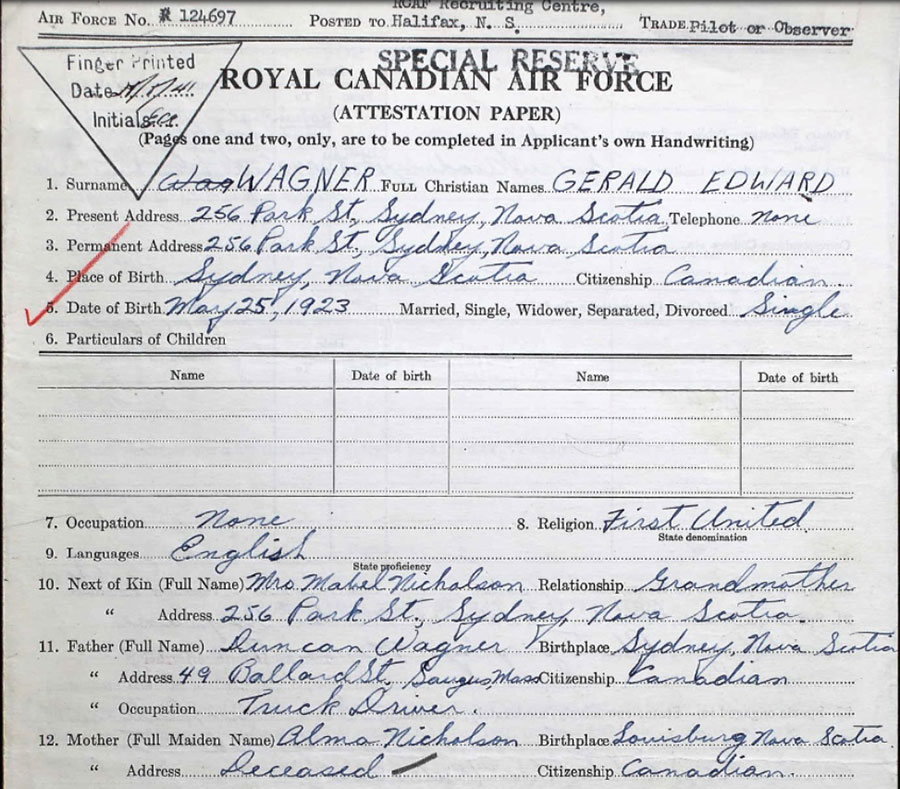
Gerald enlisted in the RCAF in September 1941. His attestation paper gives his address as 256 Park Street, Sydney, where he was living with his grandmother, Mabel Nicholson, listed as next of kin. There was no occupation listed on the form, as effectively, he was coming straight from school.
The YMCA letters that supported his application are poignant. One, written on YMCA War Services notepaper, certifies that he had proved ‘trustworthy, honest and reliable’ over four years and that he had shown good leadership qualities. Another, from the general secretary of the Sydney YMCA, calls him a willing volunteer in many services and recommends him as ‘a clean living young man worthy of my recommendation’ to the RCAF.
After acceptance, he began training as an air gunner. His RCAF medical and personnel records show that by late 1942 he had around a year of service and was fully qualified as an air gunner. This training in Canada took him through the usual sequence of ground school, aerial gunnery courses and conversion training. Once this was complete, he went overseas in May 1942, one of thousands of young Canadians crossing the Atlantic to join Bomber Command and, in his case, Coastal Command operations in Britain.
405 Squadron and RAF Beaulieu
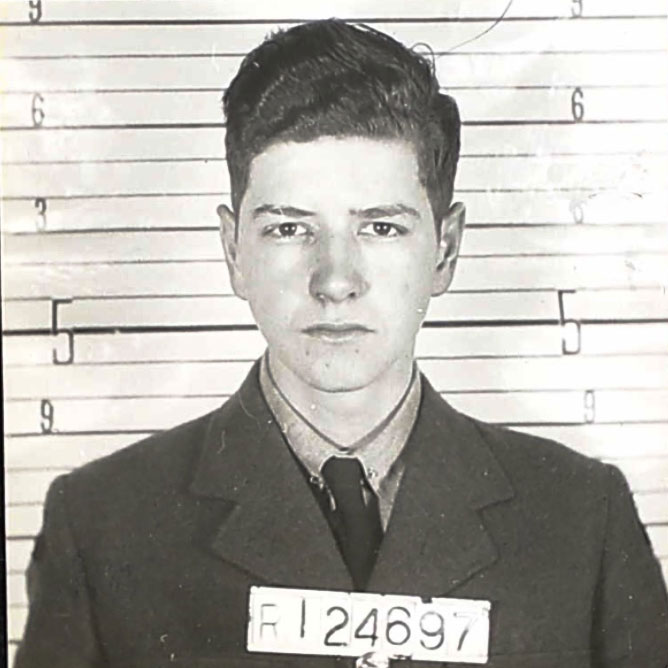
Gerald was posted to 405 Squadron, RCAF – the first Canadian bomber squadron formed overseas. By the time he joined, the unit had left its early bomber role over Germany and was operating within Coastal Command from RAF Beaulieu, flying long-range patrols over the Western Approaches and the Bay of Biscay.
From Beaulieu, 405 Squadron’s Halifax bombers were used for anti-shipping and anti-submarine patrols, mine-laying and related missions. These operations were long and hazardous in heavy Liberator aircraft.
On the day of his death, Gerald was listed as the air gunner on Handley Page Halifax Mk II W7768, code LQ-G. His work was to scan the skies and sea around the aircraft and guarding his crew against sudden attack. He was still a teenager at nineteen, but the crew depended on him.
The loss of Halifax W7768
In the early hours of that Sunday morning, W7768 took off from Beaulieu at 06:46 as the first of four Halifaxes detailed for an anti-submarine patrol. Shortly afterwards, while climbing south-west over the Isle of Wight, the aircraft suffered engine trouble. Witnesses on the ground saw the Halifax turn, lose height rapidly and dive almost vertically into the ground at Eades Farm near Newbridge, not far from Calbourne. On impact the aircraft broke up and exploded, scattering wreckage and unexploded bombs across the fields. There were no survivors.
For Gerald’s family, the news arrived by telegram and official letter. A notification of death from the Air Ministry, dated March 1943, states that Sergeant Gerald Edward Wagner, RCAF, had lost his life ‘near Colbourne, Isle of Wight, Hampshire, as the result of air operations.’ A Nova Scotia death registration, completed from those details, records simply that he had been “killed during air operations” and notes the cause as multiple injuries received in an aircraft crash.
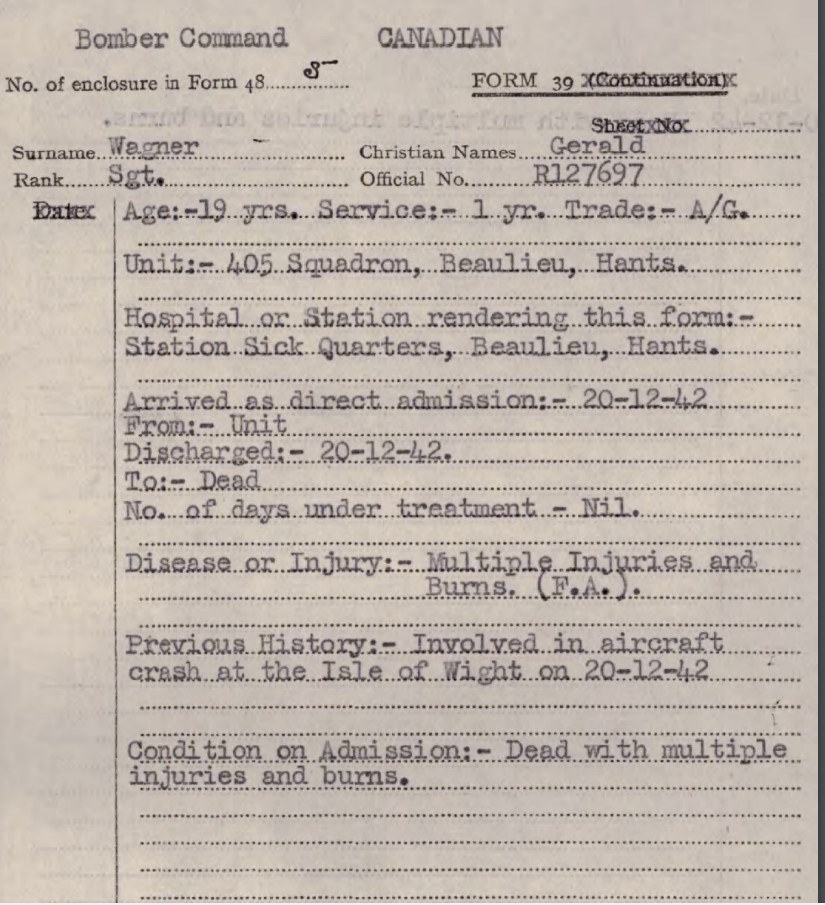
A Royal Canadian Air Force medical form from the station sick quarters at RAF Beaulieu adds one last clinical line: ‘Condition on admission: dead with multiple injuries and burns.’
Burial at Boldre
Six of the seven men from Halifax W7768, including Gerald, were buried together in the churchyard of St John the Baptist at Boldre, just a short distance from RAF Beaulieu. The Commonwealth War Graves Commission entry for Gerald records him as Flight Sergeant (Air Gunner) R/124697, Royal Canadian Air Force, 405 Squadron, the son of Duncan and Alma Wagner and grandson of Mrs A. J. Nicholson of Sydney, Nova Scotia.
Gerald’s grave is in Row 2, Grave 4. The headstone is the standard Commonwealth War Graves Portland stone with the RCAF badge and a cross.
An inscription on his headstone reads:
ASLEEP IN JESUS


