
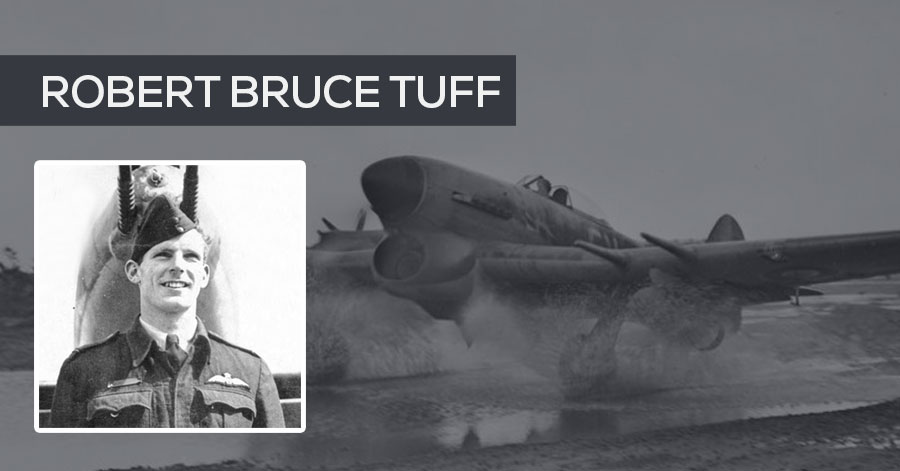
This article is in memory of Flying Officer Robert Bruce ‘Bob’ Tuff, a Royal Australian Air Force pilot serving with No. 263 Squadron RAF. On 22 February 1944, while flying his Hawker Typhoon (JR302) with No. 263 Squadron RAF, he was lost over the English Channel during a shipping reconnaissance near the Channel Islands.
Tuff was 21 years old. His body was never recovered. Today he is commemorated on the Runnymede Memorial in Surrey, and on rolls of honour in Australia and at RAF Harrowbeer.
Robert Bruce Tuff
Early life in Victoria, Australia

Robert Bruce Tuff was born on 11 July 1922 in Seddon, a suburb of Melbourne in the state of Victoria. He was the son of Robert Henry Tuff and Margaret Campbell Tuff. By the time war broke out, the Tuff family address is recorded as 123 Carpenter Street, Bendigo. He attended Bendigo High School where he excelled at cricket, football, swimming, and lawn tennis.
Before he enlisted, the nominal roll shows him living in Prahran and working in civilian life in Melbourne as a clerk in a government taxation department. Like many young Australians of his generation, the war gave him an opportunity, and a reason, to leave home and learn to fly. Service in the Royal Australian Air Force (RAAF) was entirely voluntary during the Second World War.
Joining the RAAF
Bob enlisted in the Royal Australian Air Force on 20 July 1941, in Melbourne. He was aged 19. He entered the Empire Air Training Scheme (EATS), a policy designed to train Royal Australian Air Force pilots for eventual transfer into the Royal Air Force during the war. Thousands of Australian men went through flying schools at home and then on to further training in Canada or the UK.
Flying with No. 263 Squadron RAF in Whirlwinds and Typhoons
Bob Tuff was eventually posted to No. 263 Squadron RAF, a fighter unit with a strong history of flying the Westland Whirlwind before converting to the Hawker Typhoon. The squadron’s operations record book notes that Flying Officer R. B. Tuff arrived from 59 Operational Training Unit to join 263 Squadron for flying duties.
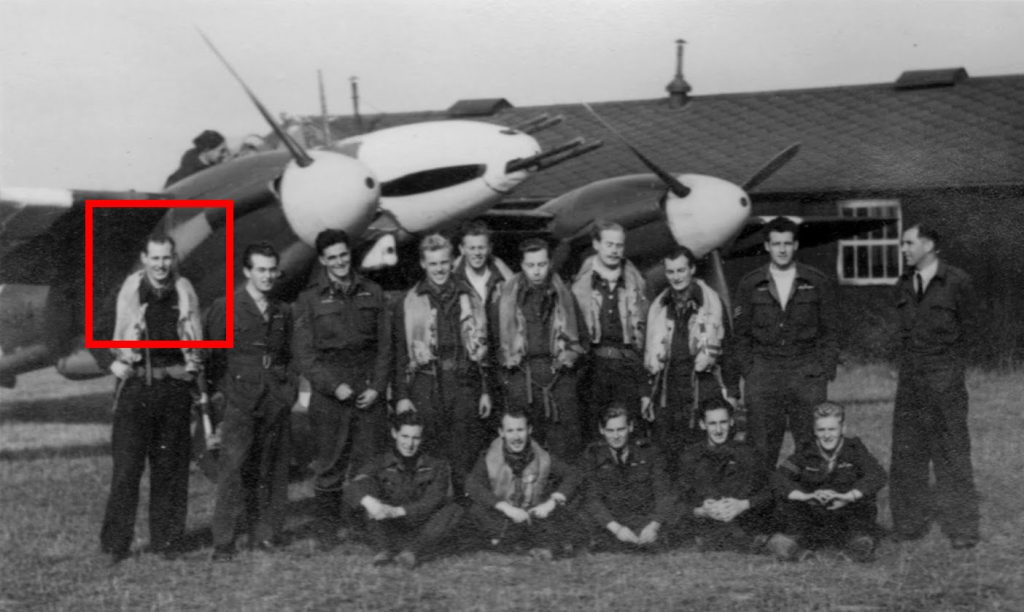
Early in his time with the unit he flew the twin-engined Whirlwind in coastal and offensive operations. A group photograph shows him among a line of squadron pilots stood in front of a Whirlwind.
By late 1943 and early 1944 the squadron had converted to the Hawker Typhoon, operating within 2nd Tactical Air Force. The unit moved to RAF Beaulieu on 1 February 1944. They were tasked with sweeps, armed reconnaissance, and shipping strikes over northern France and the Channel Islands in the run-up to the invasion of Europe.
22 February 1944 – a disastrous day for 263 Squadron
On 22 February 1944, 263 Squadron was tasked with a shipping reconnaissance (‘Rodeo 88’) west of the Channel Islands. After earlier sorties from Beaulieu, the Typhoons refuelled at RAF Harrowbeer in Devon, then took off in the afternoon for the patrol area.
In poor weather, the original sweep was curtailed. Instead, the formation carried out a shipping search in the area north-west of Guernsey. No enemy aircraft were encountered and there was no combat.
Tragedy struck.
Squadron Leader Geoffrey Berrington Warnes, the commanding officer, suffered engine failure in Typhoon MN249 and was forced to ditch in the sea about eight miles north-west of the island. Other pilots orbited while he got clear and was seen swimming towards what appeared to be an uninflated dinghy.
Seeing his CO in the water, Bob believed Warnes might be badly injured and in immediate danger. Over the radio he said that he was going to bale out and help him. Flight Lieutenant Gerald Racine, another pilot in the formation, urged him not to, but either Bob did not hear the warning clearly in the stress and noise, or he chose to ignore it.
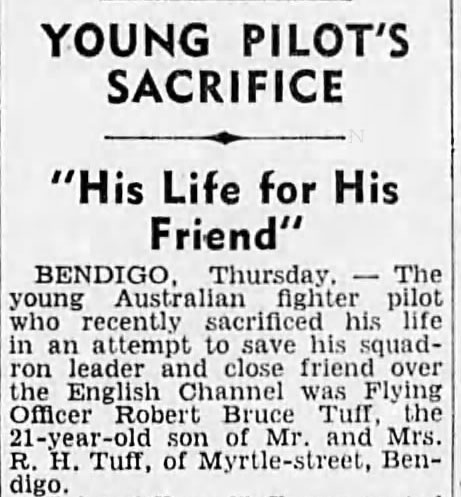
He was never seen again.
A third pilot, Flying Officer Robert Charles Hunter in Typhoon JR304, also vanished while circling the scene and was never found.
The Squadron report stated that ‘it seems certain that Flying Officer Tuff did in fact bale out in order to try and help his Commanding Officer. The weather was bitterly cold and freezing at sea level, with a moderate north east wind which made the sea rather rough.’
In a mission with no enemy action at all, three experienced pilots – the CO, a rising Australian officer, and another RAF pilot – were lost to the sea within minutes.
His parents received the following letter:
A report has been recelved from overseas head quarters the R.A.A.F. In London that during the course of a patrol the commanding officer of your son’s squadron was heard to say over the telephone that he was going to ‘ditch’ in a position approximately eight miles north-west of Guernsey. This was 11.50 a.m., and your son and other pilots orbited the spot. Your son was heard to say he had seen the C.O. in the water. He later said the C.O. was injured, and he was going to bale out and help him. Your son was not seen to bale out, but an alrcraft was seen to dive vertically into the sea at 12.10 p.m. A search was carried out at sea level, but no trace of survivors or dinghies was found. Inquiries have so far failed to reveal any further trace of your son.
Bomber Command Museum records and later accounts note that many felt Bob’s act deserved a posthumous decoration for bravery. In the end, the only award considered appropriate within the regulations was a Mention in Despatches, which he received in the London Gazette on 22 June 1944.
Commemoration in Runnymede and Bendigo
Bob’s body was never recovered, so he has no known grave. But Robert Bruce Tuff is commemorated on Panel 258 of the Air Forces section of the Runnymede Memorial, which records the names of more than 20,000 airmen who have no known resting place.
In Australia, his name appears:
- on the Australian War Memorial Roll of Honour in Canberra (panel 131)
- on the Royal Australian Air Force nominal roll and casualty lists;
- on local rolls of honour in Bendigo, Victoria.
Robert Bruce Tuff and RAF Beaulieu
Although Bob’s final sortie launched from RAF Harrowbeer, his squadron was based at RAF Beaulieu. Only three weeks earlier, 263 Squadron had become operational from the New Forest airfield on Typhoons, flying sweeps and strikes over the Cherbourg peninsula and the French coast. Beaulieu was where the squadron had re-formed as a front-line fighter unit in early 1944 after its Whirlwind days, and where Bob flew many of his Typhoon sorties from.


