

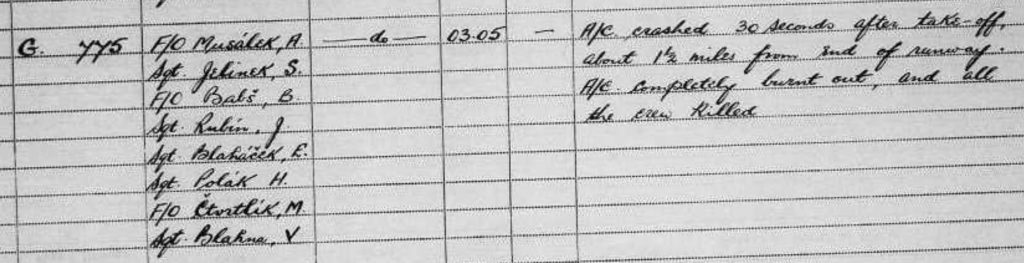
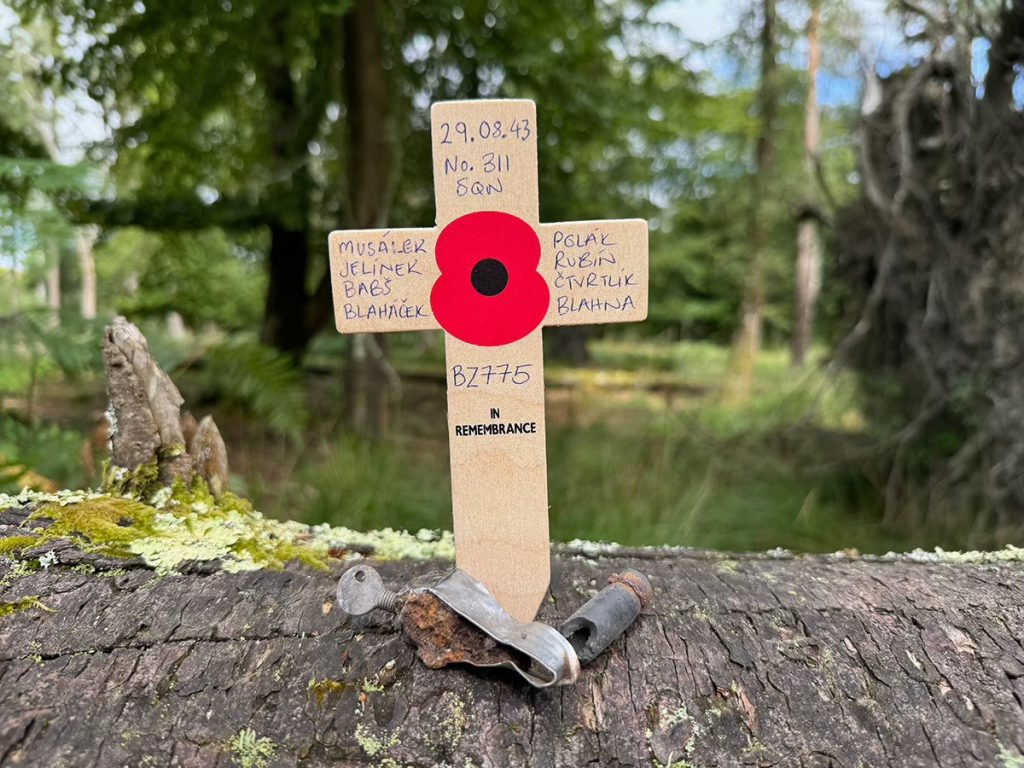
This article is in memory of eight Czechoslovak airmen who died when Liberator GR Mk V BZ775 of No. 311 (Czechoslovak) Squadron RAF crashed 30 seconds after taking-off from RAF Beaulieu in the early hours of 29 August 1943.
They were:
- F/O Adolf Musálek – pilot
- Sgt Stanislav Jelínek – second pilot
- F/Lt Bruno Babš – navigator
- F/O Miroslav Čtvrtlík – air gunner
- Sgt Jiří Rubín – wireless operator / air gunner
- Sgt Hanuš Polák – wireless operator / air gunner
- Sgt Eduard Blaháček – wireless operator / air gunner
- Sgt Václav Blahna – air gunner
All eight are buried in the Czechoslovak section of Brookwood Military Cemetery in Surrey, their headstones grouped around the national memorial that commemorates Czechoslovak aircrew who died while serving with the RAF.
No. 311 (Czechoslovak) Squadron RAF at Beaulieu
By the summer of 1943, 311 Squadron had moved from Bomber Command into Coastal Command, swapping Wellingtons for the much larger four-engined American made Consolidated B-24 Liberators. RAF Beaulieu in the New Forest became their new home.
From Beaulieu, the Czechoslovak crews went on missions to hunt down German U-boats and also protect Allied shipping in the Bay of Biscay. These were long (sometimes up to 12 hours), tiring patrols over water, often at low level.
The switch from twin-engined Wellingtons to Liberators loaded with depth charges was not a simple one. Many crews were still gaining experience on the new type during 1943, even as they were being thrown into front-line anti-submarine operations.
August 1943 – the darkest month at RAF Beaulieu
In my separate article and YouTube film August 1943: The Darkest Month in Beaulieu Airfield’s History, I’ve looked at how this one month brought an almost unbelievable series of tragedies to the station. Among them were:
- 13 August – the mid-air collision between Halifax JB902 and Wellington MP622 near Sway – the biggest loss of a life in a New Forest air crash.
- 21 August – Liberator BZ780 of 311 Squadron lost without trace over the Bay of Biscay
- 29 August – Liberator BZ775 crashing on take-off at Beaulieu
- 30 August – the death of Andrej Šimek.
- 30 August – Liberator BZ785 crashing at Dilton Copse near Brockenhurst during a training flight
The loss of BZ775 sits right in the middle of this sequence. It is one of the events that, for me, justifies calling August 1943 the darkest month in RAF Beaulieu’s wartime story. Here’s the video I made.
The last flight of Liberator BZ775
Liberator GR Mk V BZ775, coded “G”, had been delivered to 311 Squadron in January 1943. On the night of 28/29 August it was prepared at Beaulieu for another anti-submarine patrol over the Bay of Biscay. The aircraft was heavily loaded: contemporary accounts describe it carrying twelve depth charges and over 2,300 gallons of fuel for the long sortie.
The crew assembled in the small hours of the morning. Weather conditions were reasonable and no technical problems were recorded with the Liberator during pre-flight checks. At 03:05 the aircraft began its take-off run along the Beaulieu Airfield runway.
According to witnesses, Liberator BZ775 did not seem to accelerate as expected. Near the end of the runway the pilot attempted to lift off; the aircraft became airborne briefly, then settled back, bounced, and a second attempt was made. On the final attempt the big Liberator failed to gain sufficient height and started to decline.
She struck trees beyond the airfield perimeter, at Hawkhill Inclosure to the north of the airfield, and crashed, breaking apart and burning fiercely. The aircraft was fully laden with depth charges, so all eight men on board had no chance.

There were no survivors. All were killed instantly.
Investigators later concluded that the aircraft had ‘failed to attain flying speed’. No clear mechanical cause was identified. The heavy load, marginal runway length, darkness, and the squadron’s still-limited experience on Liberators may all have played a part. The crash report stated:
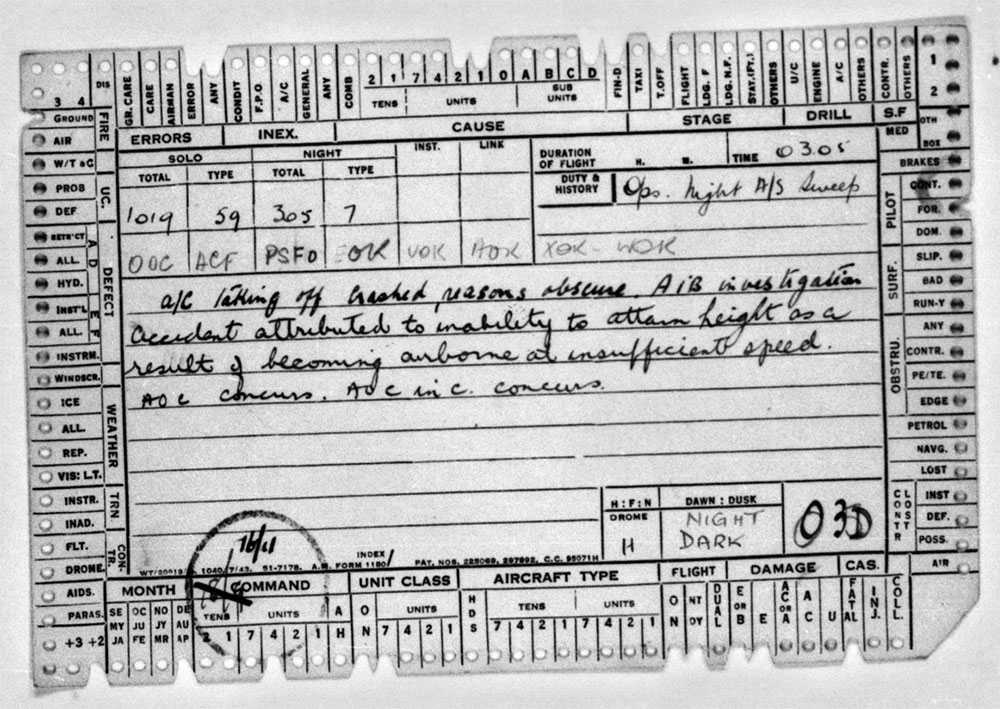
Accident attributed to inability to attain height as a result of becoming airborne at insufficient speed.
One haunting detail emerges from Czechoslovak sources: the crew’s usual wireless operator, Warrant Officer Jaromír Bajer, missed the take-off due to a delay, and another man flew in his place. Bajer would later be remembered as one of the squadron’s luckiest survivors – his life story earning him the nickname ‘Klikař Roger’ which meanly translates roughly into English as ‘Jammy Roger’.
The men of Liberator BZ775
Each member of the crew had already travelled a long and dangerous road from Nazi-occupied Europe to the New Forest. The details we have are incomplete, but even a brief outline I have managed to compile, shows the scale of their sacrifice.
Flying Officer Adolf Musálek (26) – pilot
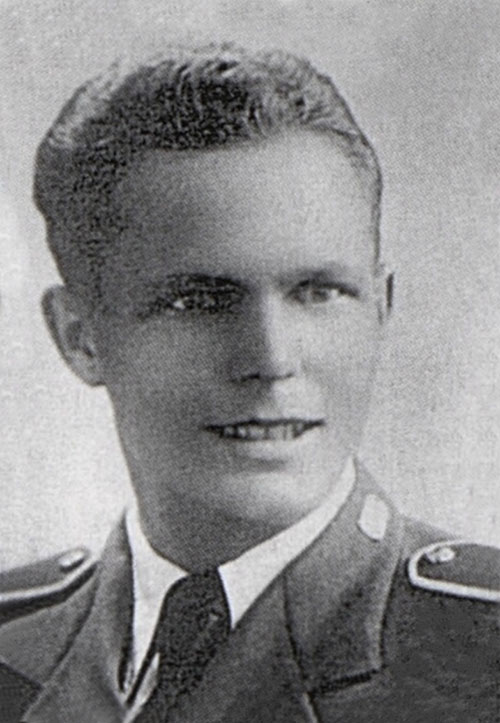
Adolf Musálek was born on 3 October 1916 in Svinov, near Ostrava, in what was then Czechoslovakia. He attended the military flying school at Prostějov from 1935 and became a pilot in the peacetime Czechoslovak Air Force. After the German occupation, he escaped abroad and, by September 1940, had reached Britain.
In the UK he joined 311 Squadron as a bomber pilot and flew a remarkable total of 53 operational sorties in Wellingtons over Germany and occupied Europe. Later he converted onto Liberators for Coastal Command operations which he would fly from RAF Beaulieu. By August 1943 he was an experienced and highly regarded officer, trusted with command of a Liberator crew. He had already lived through more than three years of war flying.
He is buried in the Czechoslovak Memorial plot at Brookwood Military Cemetery, row 28, grave B.4.
Sergeant Stanislav Jelínek (23) – second pilot
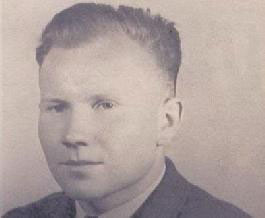
Stanislav Jelínek was born on 22 April 1920 in Zdětín. Like many of his generation he came of age just as his country was being broken up and occupied.
He served as second pilot on the aircraft – a vital role on long Liberator sorties. Flying four-engined patrol aircraft over the Atlantic was demanding work, requiring close teamwork on the flight deck.
He is buried in the Czechoslovak Memorial plot at Brookwood Military Cemetery, row 28, grave A.2.
Flight Lieutenant Bruno Babš (37) – navigator

Bruno Babš was the oldest member of the crew, born on 16 September 1905 at Lipník nad Bečvou. Before the war he studied at a higher state technical school specialising in electrical engineering, then trained as an air force officer.
After the Munich crisis he left Czechoslovakia for exile in August 1939, served briefly with the Czechoslovak forces in Poland, and was then imprisoned in the Soviet Union. Released via the Middle East, he eventually reached Britain in 1941, joined the RAF and trained as aircrew.
In March 1943 he was posted to 311 Squadron as a navigator. On Liberator patrols the navigator’s work was constant – plotting position over featureless sea, calculating fuel, organising search patterns, and guiding the aircraft back to whatever base the weather and fuel state permitted.
He is buried in the Czechoslovak Memorial plot at Brookwood Military Cemetery, row 28, grave B.2.
Flying Officer Miroslav Čtvrtlík (28) – air gunner
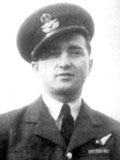
Miroslav Čtvrtlík was born on 12 October 1914 in Olomouc.
As an air gunner on a Liberator, he would have been responsible for defending the aircraft against enemy fighters over the Bay of Biscay. It was a dangerous duty, particularly when long-range German aircraft and fighters hunted Coastal Command patrols.
He is buried in the Czechoslovak Memorial plot at Brookwood Military Cemetery, row 28, grave B.3.
Sergeant Jiří Rubín (24) – wireless operator / air gunner

Jiří Rubín, a wireless operator and air gunner, was born on 29 November 1919 in Prague. Wireless operators on Coastal Command Liberators had a double role. They handled radio traffic, bearings and communications, but also manned gun positions, keeping watch for enemy aircraft and surface targets.
He is buried in the Czechoslovak Memorial plot at Brookwood Military Cemetery, row 28, grave A.1.
Sergeant Eduard Blaháček (23) – wireless operator / air gunner
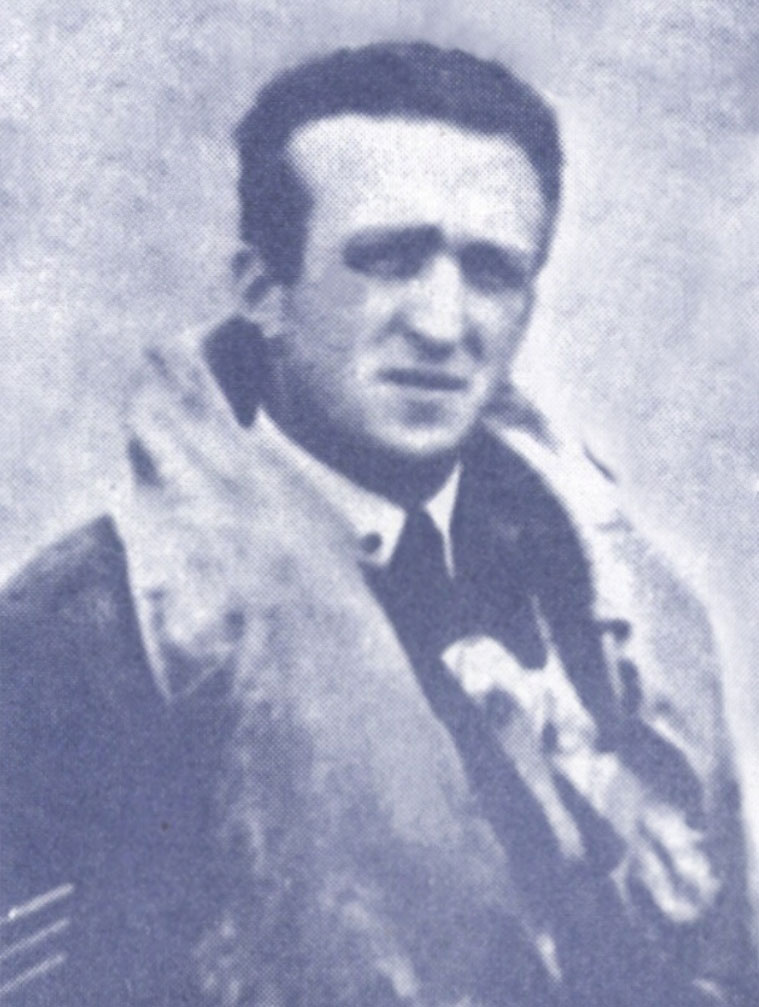
Eduard Blaháček was born on 20 October 1919 in Postřelmov, in Moravia. He attended a municipal school, completed non-commissioned officer training and specialised as a radio operator and gunner before joining the RAF.
Like so many of his comrades he later received posthumous promotions and decorations from the re-established Czechoslovak state, but those honours could not restore the life lost, thirty seconds after take-off from RAF Beaulieu.
He is buried in the Czechoslovak Memorial plot at Brookwood Military Cemetery, row 28, grave B.8.
Sergeant Václav Blahna (27) – air gunner
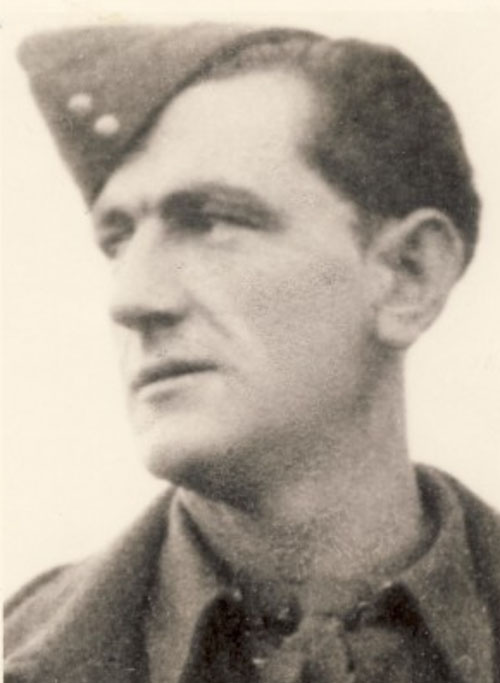
Václav Blahna was born on 13 September 1915 in Blovice, near Plzeň, into a working-class family. He trained as a metalworker and worked at the Škoda works in Plzeň, gaining experience with machinery and learning to fly light aircraft at the local airfield.
After the German occupation he escaped from the Protectorate in August 1939, travelled via Poland, Romania and France, and eventually reached Britain. There he first served in the Czechoslovak infantry before being accepted into the RAF in 1942. By June 1943 he was with 311 Squadron at Beaulieu as an air gunner, flying anti-submarine patrols.
Blahna had married an English woman, Jessie, not long before his death. He is buried in row 28, grave B.9 at Brookwood. Standing in front of his headstone you are reminded that the losses of BZ775 were felt not only in Czechoslovakia, but also in homes and families here in Britain.
He is buried in the Czechoslovak Memorial plot at Brookwood Military Cemetery, row 28, grave B.9. You can read more about him on this profile I wrote.
Sergeant Hanuš Polák (20) – wireless operator / air gunner

Hanuš Polák was the youngest members of the crew, born on 21 October 1922 in Prague. He was only twenty years old at the time of his death in the New Forest. He had been a pupil at Bembridge School on the Isle of Wight before the war, giving him a poignant local connection to southern England.
He is buried in the Czechoslovak Memorial plot at Brookwood Military Cemetery, row 28, grave B.7.
Brookwood Military Cemetery and remembrance
After the crash, the remains of the crew were taken from RAF Beaulieu and interred together at Brookwood Military Cemetery in Surrey. They rest in the dedicated Czechoslovak section, laid out around a national memorial. The plot was created during the war specifically to accommodate Czechoslovak airmen who died while serving with the RAF around London and southern England.
Today visitors walking down Long Avenue at Brookwood can stand at row 28, B-2 to B-4 and B-7 to B-9, and row 28, A-1 and A-2, and read the names of the eight men who died at Beaulieu:
The crash site today
The crash site itself lies in Hawkhill Inclosure, north of the airfield, not far from where bombs and ammunition for RAF Beaulieu were once stored and moved by tractor trailers.
In my ‘Darkest Month’ film I visit the location with my friend and historian Richard Reeves, talking through the events of that night and how they fit into the wider pattern of losses in August 1943.
We placed a wooden cross down in the memory of these brave men.
Credits and references
- RAF Beaulieu Operational Records Book
- RAF accident report cards
- https://fcafa.com/2012/04/02/liberator-aircraft-of-311-sqn/
- https://fcafa.com/2011/05/04/brookwood/
- https://fcafa.com/2015/09/12/311-sqn-never-regard-their-numbers-coastal-command/
- https://cz-raf.webnode.cz/czechoslovak-units/a311-squadron/no-311-squadron-accidents/bz755
- https://www.vets.cz/vpm/adolf-musalek-886
- https://www.armedconflicts.com/Babs-Bruno-t89771
- https://fcafa.com/2018/10/27/project-czraf-100/
- https://www.valka.cz/Blahacek-Eduard-t273188
- https://cs.wikipedia.org/wiki/Václav_Blahna_(palubní_střelec)
- https://cs.wikipedia.org/wiki/Eduard_Blaháček
- https://cs.wikipedia.org/wiki/Adolf_Musálek
- https://www.armedconflicts.com/Ctvrtlik-Miroslav-t273190


